EdbMails EDB Recovery and Migration software
  • Products
    EdbMails
    All-in-one Recovery and Migration
    Explore our products
    • EDB recovery and Migration
    • OST, PST, MBOX, NSF, EML, MSG
    • Office 365, Exchange Migration
    • SharePoint, OneDrive & Teams
    • G Suite Migration
    • IMAP Migration
    • Duplicate Remover
    • Windows Data Recovery
    • Backup Solutions

    EDB Recovery and Migration

    EdbMails lets you recover corrupted, damaged, and offline Exchange EDB files, convert EDB mailboxes to PST format, and directly migrate mailbox data to Office 365 and live Exchange Server.

    EDB to PST
    Recover corrupted, damaged, offline EDB files and convert Exchange EDB mailboxes to PST file format
    Public Folder to Exchange
    Migrate public folders from an Exchange offline EDB file to live Exchange Server
    EDB to Live Exchange Migration
    Directly migrate offline Exchange database (EDB) files to live Exchange server
    Archive Mailbox to Office 365
    Migrate archive mailboxes from offline EDB files directly to Office 365
    EDB to Office 365 Migration
    Directly migrate offline Exchange database (EDB) files to Office 365
    Public Folder to Office 365
    Migrate public folders from an offline Exchange EDB file to Office 365

    OST, PST, MBOX, NSF, EML, MSG Export and Migration

    EdbMails lets you to recover OST and PST files, export OST, PST, MBOX, NSF, EML, and MSG files to PST files, and directly migrate OST, PST, MBOX, and NSF mailbox data to Office 365 and live Exchange Server.

    OST Recovery and Migration
    Recover offline OST files, convert OST to PST, and migrate OST to Office 365 and Exchange Server
    PST Recovery and Migration
    Recover Outlook PST files , Export PST to PST, migrate PST to Office 365 and Exchange Server
    MBOX Export and Migration
    Export MBOX to PST, migrate MBOX to Office 365 and Exchange Server
    NSF Export and Migration
    Export NSF to PST, migrate NSF to Office 365 and Exchange Server
    EML to PST Export
    Convert EML files to Outlook PST files
    PST to MSG Export
    Convert Outlook PST file to MSG file format
    MSG to PST Export
    Export MSG files to Outlook PST files

    Office 365, Exchange Migration

    EdbMails lets you securely migrate mailboxes across Microsoft 365, Exchange, Google Workspace (G Suite), and IMAP-supported servers such as Outlook, Gmail, Zimbra, Zoho Mail, and cPanel, ensuring zero downtime.

    Office 365 Migration
    Migrate between Office 365 tenants, Office 365 to Exchange, Office 365 to PST, PST files to Office 365.
    Exchange Migration
    Migrate between any Exchange Servers, Exchange to Office 365, Exchange to PST, PST files to Exchange.
    Tenant to Tenant Migration
    Migrate Mailboxes, Public Folders, Archive Mailboxes between Office 365 Tenants.
    Exchange to Office 365
    Migrate Mailboxes, Public Folders, Archive Mailboxes from live Exchange server to Office 365.
    Office 365 to IMAP
    Migrate Office 365 to IMAP, Office 365 to Gmail, Office 365 to Outlook, Office 365 to Zoho etc.
    Exchange to IMAP
    Migrate from live Exchange Server to IMAP servers such as Gmail, Outlook, and Zoho Mail.
    Public Folder to Office 365
    Migrate Public Folders between Office 365 tenants with complete folder hierarchy and mailbox data integrity.
    Exchange to PST
    Export live Exchange Server mailboxes, public folders, and archive mailboxes to Outlook PST files.

    SharePoint, OneDrive & Microsoft Teams Migration

    EdbMails lets you migrate SharePoint sites, OneDrive data, Microsoft Teams, teams, channels, chats, permissions, and documents between Microsoft 365 tenants while maintaining the existing folder structure and data integrity.

    SharePoint Online Migration
    Migrate documents, lists, files and folders from SharePoint sites.
    OneDrive for Business Migration
    Migrate documents, lists, files, folders, private chats from OneDrive.
    Microsoft Teams Migration
    Migrate Teams, chats, channels, documents, files and folders etc.

    Google Workspace / G Suite Migration

    EdbMails G Suite Migration Tool lets you easily migrate emails, calendars, contacts, tasks, and more from G Suite to Office 365, Exchange Server, and IMAP servers using a Google Admin account without requiring individual user credentials.

    G Suite Migration
    Migrate emails, calendars, contacts, tasks from G Suite to Office 365, G Suite to Exchange, G Suite to IMAP Servers
    G Suite to Office 365
    Migrate emails, calendars, contacts, tasks from Google Workspace / G Suite to Office 365
    G Suite to Exchange Server
    Migrate emails, calendars, contacts, tasks from Google Workspace / G Suite to on-Premise Exchange Server
    G Suite to IMAP
    Migrate emails, calendars, contacts, tasks from Google Workspace / G Suite to IMAP, Outlook, Zimbra, Zoho etc.

    IMAP Migration

    EdbMails IMAP Migration tool lets you easily migrate emails from IMAP servers such as Outlook, Gmail, Zoho Mail, Zimbra, cPanel, and more. Supports IMAP to IMAP, Office 365, Exchange Server, PST, and bulk PST to IMAP migration.

    IMAP Email Backup & Migration
    Backup and migrate emails from IMAP servers to PST, Office 365, and On-Premises Exchange Server
    IMAP to Office 365
    Migrate emails, folders, and attachments from IMAP servers to Office 365
    IMAP to Exchange
    Migrate emails, folders, and attachments from IMAP servers to on-premises Exchange Server
    IMAP to PST
    Export emails, folders, and attachments from IMAP servers to Outlook PST files for backup
    PST to IMAP
    Migrate emails, folders, and attachments from bulk PST files to IMAP servers

    Duplicate Remover

    EdbMails Duplicate Remover lets you easily remove duplicate items from Office 365 and Exchange Server, and from IMAP, Outlook, Gmail, Zimbra, Zoho Mail, etc., ensuring a clean and organized mailbox.

    Remove Duplicates
    Easily clean up your Office 365, Exchange, Outlook and IMAP accounts by removing duplicate emails.
    Remove Duplicates from Office 365
    Remove duplicate emails, calendars, contacts, journal tasks, etc. from Office 365.
    Remove Duplicates from Exchange Server
    Remove duplicate emails, calendars, contacts, journal tasks, etc. from live Exchange Server.
    Remove Duplicates from IMAP, Outlook
    Remove duplicate emails, attachments from IMAP, Outlook, Gmail, Zimbra, Zoho Mail etc.

    Exchange, SharePoint, OneDrive, Teams and Office 365 Backup

    EdbMails enables secure, automated backup and recovery for Microsoft 365 services including Exchange Online, SharePoint, OneDrive, Teams, and Live Exchange Server with complete data protection and restore flexibility.

    Office 365 Backup
    Incremental, Granular, Encrypted and Compressed Office 365 Mailboxes Backup
    Exchange Server Backup
    Incremental, Granular, Encrypted and Compressed Exchange Mailboxes Backup
    SharePoint, OneDrive & Teams Backup
    Backup Online site collections, Team sites, Office 365 groups, all documents etc.

    Windows Data Recovery

    EdbMails Windows Data Recovery Software lets you recover permanently deleted data, including photos, videos, documents, and archived files, from partitions on hard drives, SSDs, USB drives, SD cards, and external storage devices.

    Windows Data Recovery
    Recover and restore permanently deleted data from hard drives, SSDs, USB drives, SD cards, and etc.
    Whitepaper
    Request a Demo
    Sign Up
  • Features
  • FAQ
  • Pricing
  • Download
  • Support
  • Sign in
User’s Manual
SharePoint Migration

User Manual

User Manual

  • FAQ
    • SharePoint Migration
    • OneDrive Migration
    • Microsoft Teams Migration
    • Office 365 Migration
  • Videos
    • SharePoint Migration
    • OneDrive Migration
    • Microsoft Teams Migration
    • Office 365 Migration
  • Screenshots
    • SharePoint Migration
    • OneDrive Migration
    • Microsoft Teams Migration
    • Office 365 Migration
  • How it works?
    • SharePoint Migration
    • Create a SharePoint site
    • Enable site/subsite creation
    • Add admin as SharePoint site member
    • Disable audit logs in SharePoint
    • OneDrive Migration
    • Microsoft Teams Migration
  1. Home
  2. Product
  3. Step by Step Guide for SharePoint Online Migration
Download Buy Now

SharePoint Migration Step-by-step guide

EdbMails offers a dedicated SharePoint migration tool designed to facilitate SharePoint data migration between Microsoft 365 (Office 365) tenants. The software supports the migration of a wide range of SharePoint data, including site collections, subsites, lists, libraries, documents, site contents, files, folders, and more.

A standout feature of EdbMails is its ability to perform simultaneous migrations of multiple SharePoint sites. This significantly boosts migration performance and enables efficient handling of large volumes of data. The tool also supports installation on multiple computers, allowing users to run parallel migrations to different target sites—further enhancing speed and scalability.
SharePoint Migration

EdbMails supports incremental migration, ensuring that only newly added or modified data is transferred during subsequent operations. This smart approach reduces bandwidth usage and avoids re-migrating existing content.

In the sections that follow, you'll find details on pre-migration activities, step-by-step migration instructions, best practices, and the key benefits of using EdbMails for SharePoint migration.

  1. SharePoint Pre-Migration Activities

    On Source server:

    1. Get the SharePoint source server URL, Admin center url, Office 365 Admin account, Password
    2. Grant admin access to each SharePoint site. You can choose to let EdbMails automatically grant admin access through the SharePoint login window. However, if you prefer to grant admin access manually, refer to the link below:

        Steps to add Global admin as a member of each SharePoint site on the source server.

    On Target server:

    1. Get the SharePoint target server URL, Admin center url, Office 365 Admin account, Password.
    2. Create the SharePoint sites on the target server. EdbMails can automatically create these sites for you, saving time and effort. If you'd rather create the sites manually, check the link below for detailed instructions.

       Steps to create sites on SharePoint server.

    3. Make sure each SharePoint site on the target server has admin access. EdbMails can handle this automatically through the SharePoint login window. If you’d rather do it yourself, follow the manual steps in the link below.

       Steps to add Global admin as a member of each SharePoint site on the target server.

    4.  Ensure to enable the option to create sites / subsites on your target SharePoint server.

  2. SharePoint Migration Steps

    EdbMails offers a user-friendly software interface that allows you to migrate SharePoint site data with minimal clicks. The software automatically maps sites between your source and target servers. Follow the steps below to successfully migrate your SharePoint site data using the EdbMails SharePoint migration tool.

    • Step 1: Download and Install EdbMails SharePoint Migration Software

      • Download and install EdbMails software on your computer.
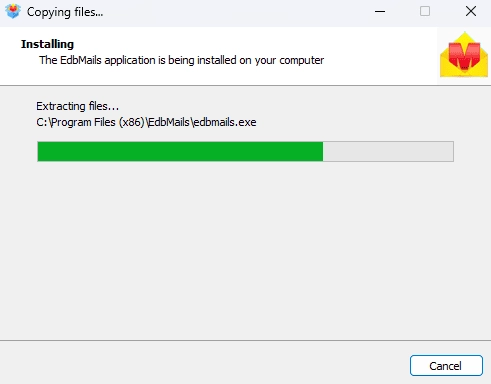
        EdbMails software installation

      • Launch the EdbMails application
      • Enter the email address & password and click ‘Login’ or ‘Start Your Free Trial’.
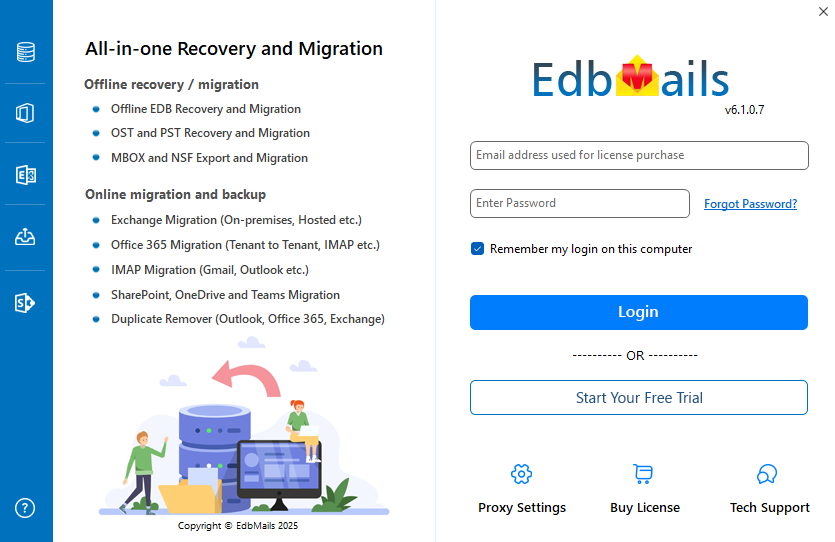
        Login to EdbMails application

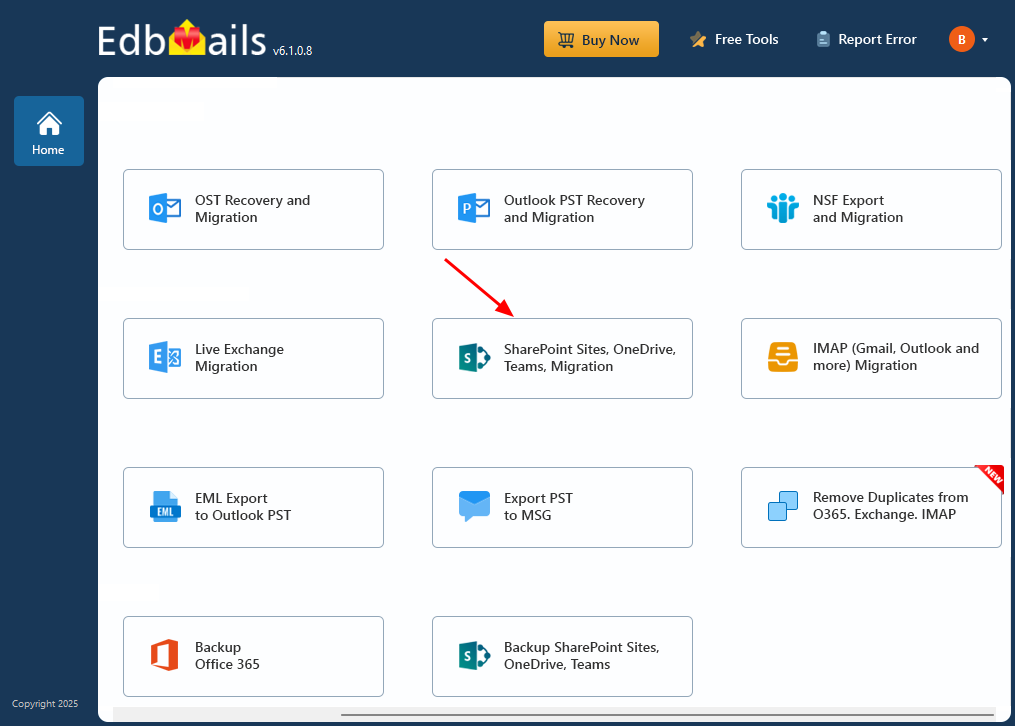
      • Select ‘SharePoint Sites, OneDrive, Teams, Migration’.

        Select ‘SharePoint sites, OneDrive, Teams, Migration’.

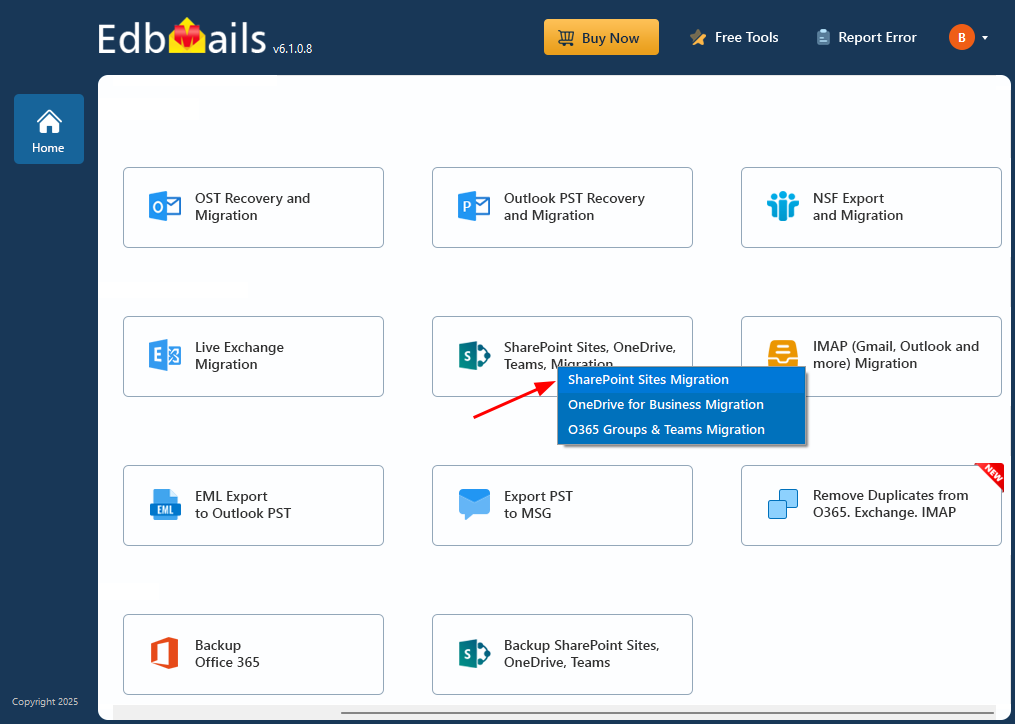
      • Select ‘SharePoint Sites Migration’.

        Select SharePoint Site Migration

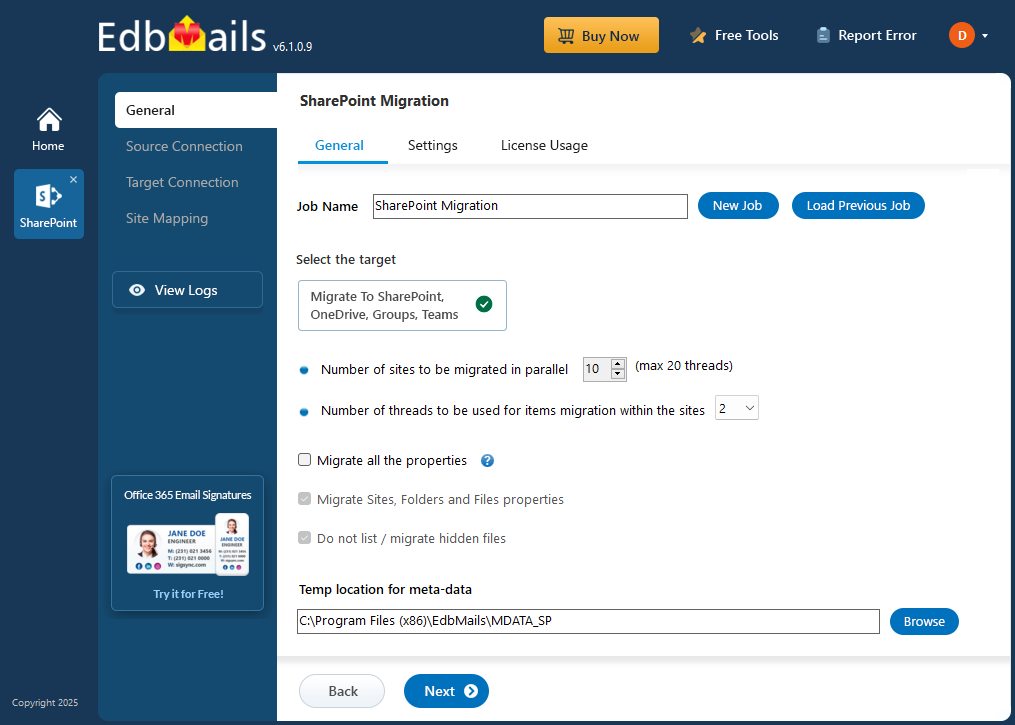
      • You can either keep the default job name or click the ‘New Job’ button to change the job name.
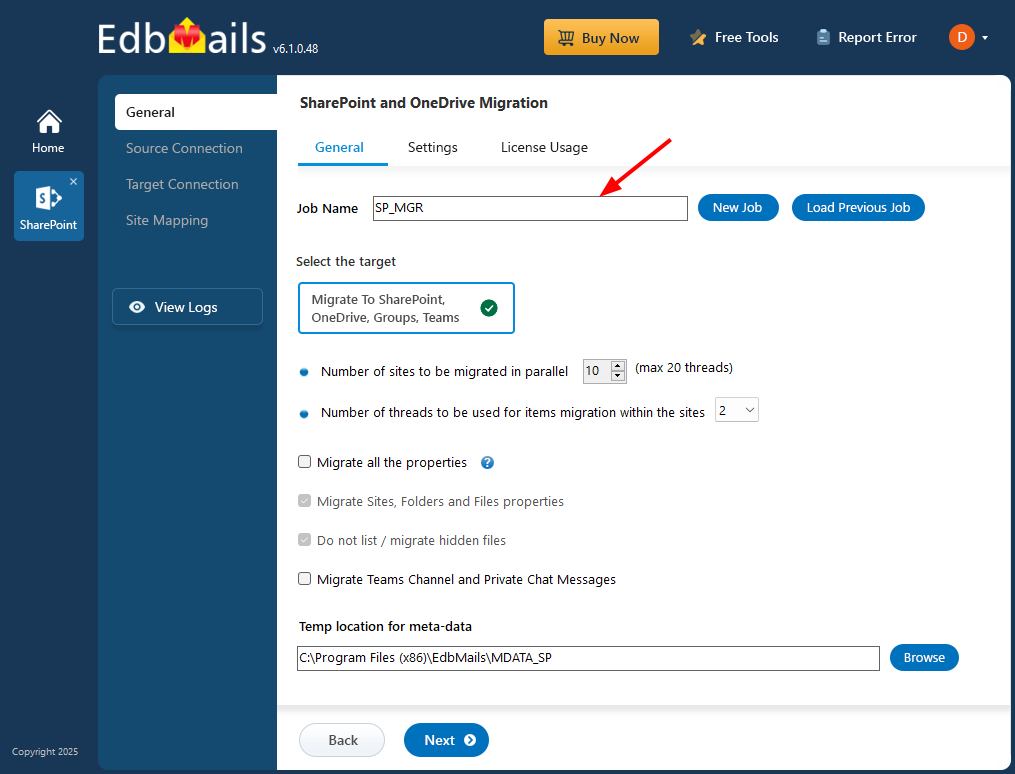
        Enter SharePoint Migration job name

    • Step 2: Connect to SharePoint Source server

      • Enter the source SharePoint server url, admin center url, Office 365 Global admin account email address and password.
      • Then, click the ‘Grant Required Permissions’ button.
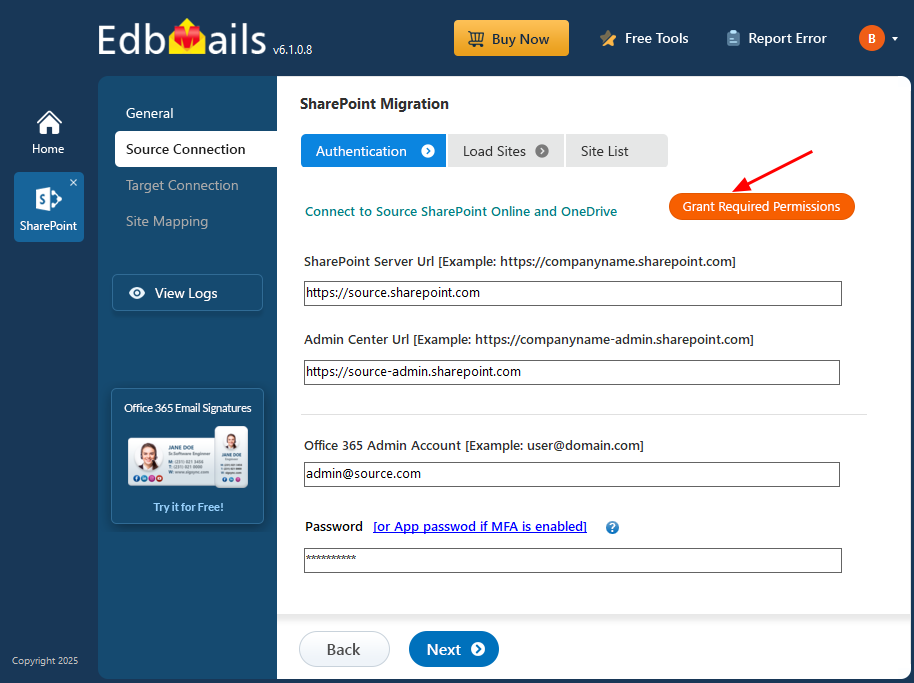
        Connect to the SharePoint Source Server.

      • Check the option ‘Grant permissions to selected SharePoint sites’
      • Check the option ‘All Sites (Members) or ‘Only selected Sites (Members)’
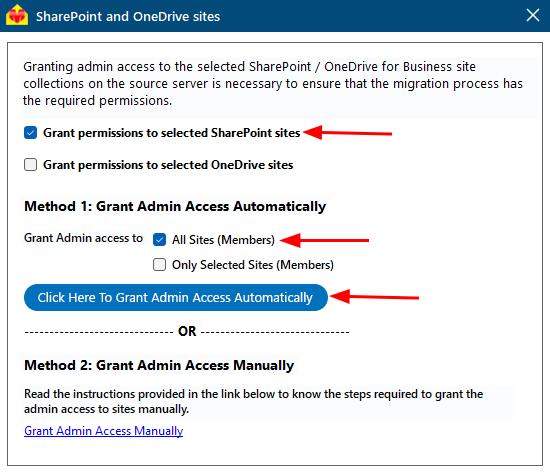
        Click to Grant Admin access Automatically

      • A PowerShell window will appear in the taskbar, prompting you to authenticate on the Microsoft Sign-In page with a Global admin account.

        Note: Keep checking the taskbar, as you may be prompted to authenticate multiple times.
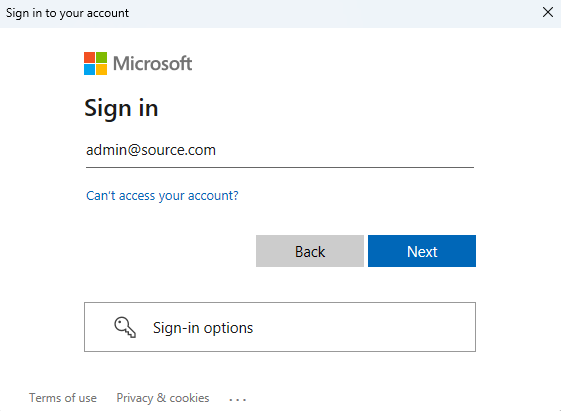
        Microsoft sign-in page

      • Select the required sites to set the permissions from the list, then click ‘Continue’.
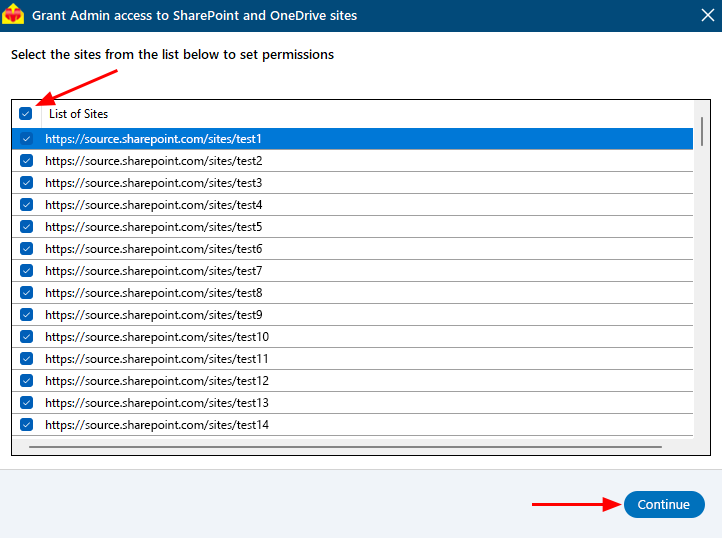
        Select all the sites

      • A PowerShell window will pop up in the taskbar, asking you to sign in with a Global Admin account on the Microsoft Sign-In page.

        Microsoft sign-in page

      • After signing in, you’ll see the progress of admin access being granted to the selected SharePoint sites.
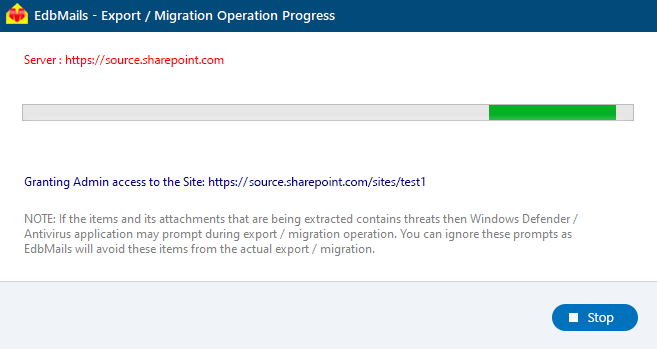
        Granting Admin access progress

      • Once permissions are granted to the selected sites, a confirmation message will appear.
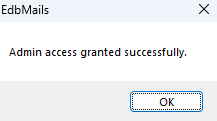
        Admin access granted  successfully

      • If you want to manually grant the admin access, refer to the link below:

          Steps to add Global admin as a member of each SharePoint site on the source server.

      • Select one of the authentication methods and click the ‘Login’ button to continue

        Connect to the Source SharePoint server

      • If you want to manually register the EdbMails application in Azure Active Directory (AD), click here for the steps.
      • Select one of the methods to load the SharePoint Sites. If you have additional sites that are not listed you load the sites using .CSV file.
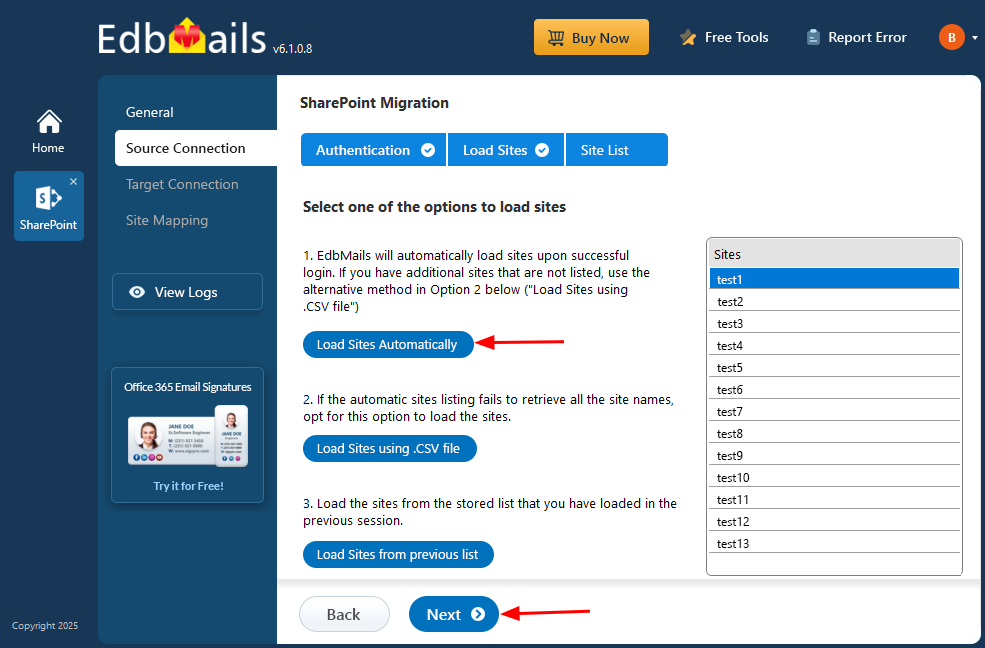
        Select option to Load Mailboxes

    • Step 3: Select the SharePoint Sites

      • Select the SharePoint sites for migration and click ‘Next’ to continue
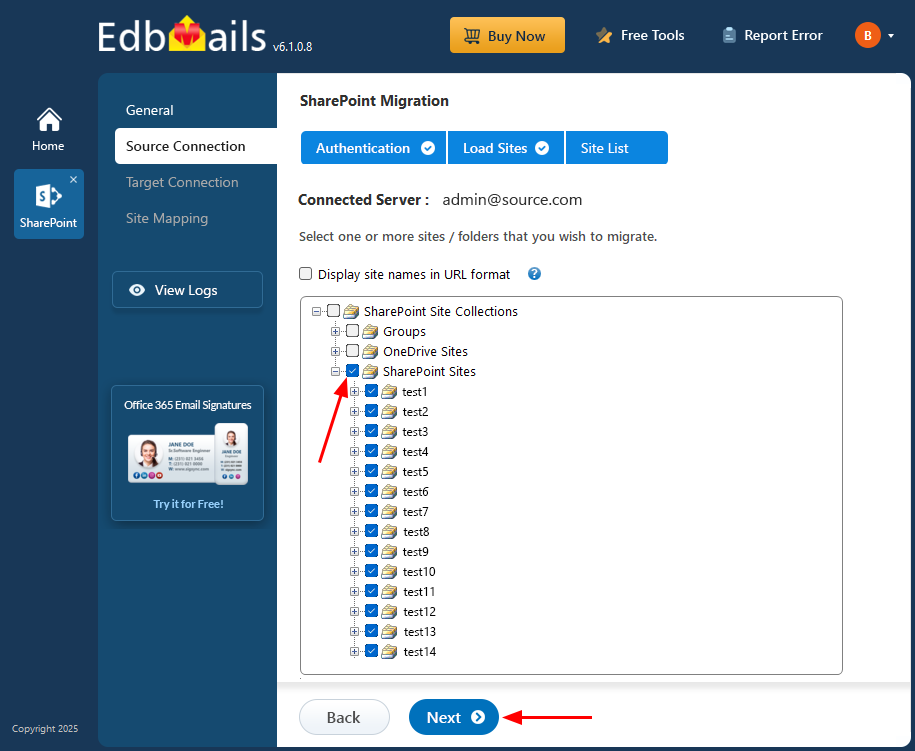
        Select required Mailboxes

    • Step 4: Connect to target SharePoint server

      • Enter the target SharePoint server url, admin center url, Office 365 Global admin account email address and password.
      • Then, click the ‘Grant Required Permissions’ button.
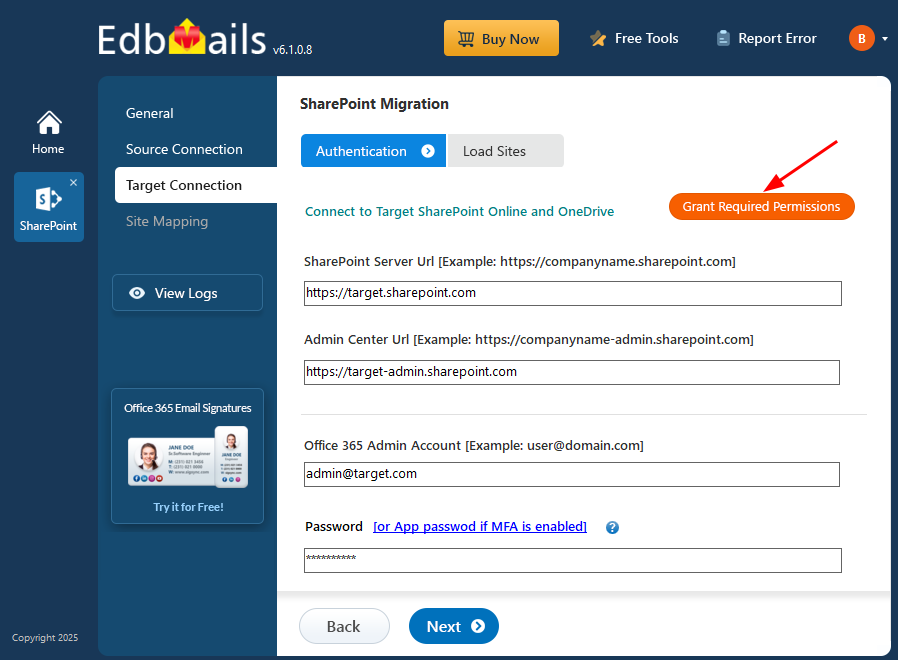
        Connect to the target SharePoint Server.

      • Check the option ‘Grant permissions to selected OneDrive sites’.
      • Check the option ‘All Sites (Members)' or ‘Only selected Sites (Members)’.

        Click Grant Admin access Automatically

      • A PowerShell window will appear in the taskbar, prompting you to authenticate on the Microsoft Sign-In page with a Global admin account.

        Note: Keep checking the taskbar, as you may be prompted to authenticate multiple times.
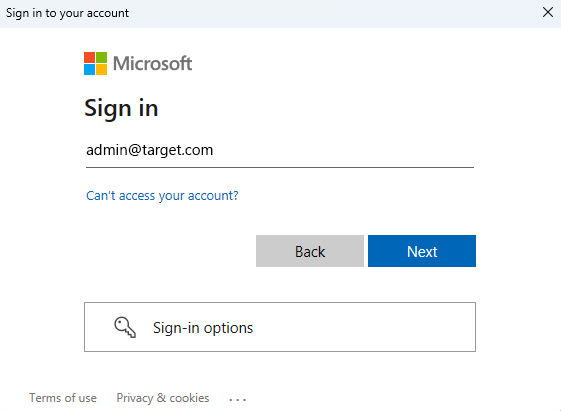
        Target Microsoft sign-in page

      • Select the required sites to set the permissions from the list, then click ‘Continue’.
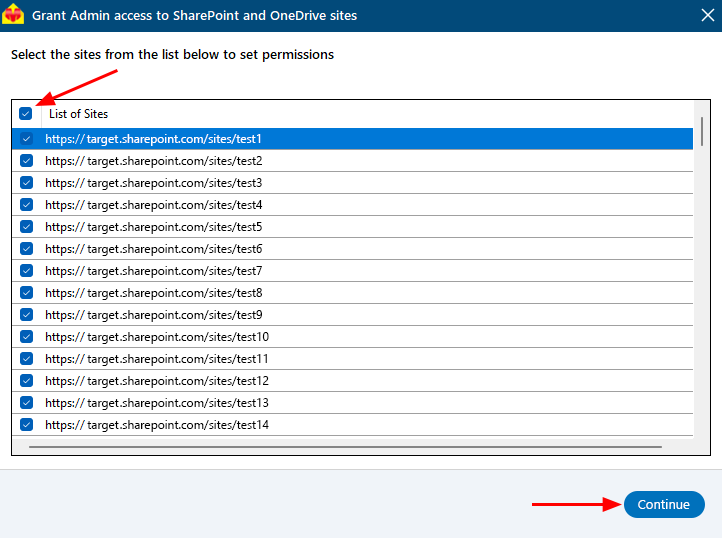
        Select the target sites

      • A PowerShell window will pop up in the taskbar, asking you to sign in with a Global Admin account on the Microsoft Sign-In page.

        Target Microsoft sign-in page

      • After signing in to the target server, you’ll see the progress of admin access being granted to the selected SharePoint sites.
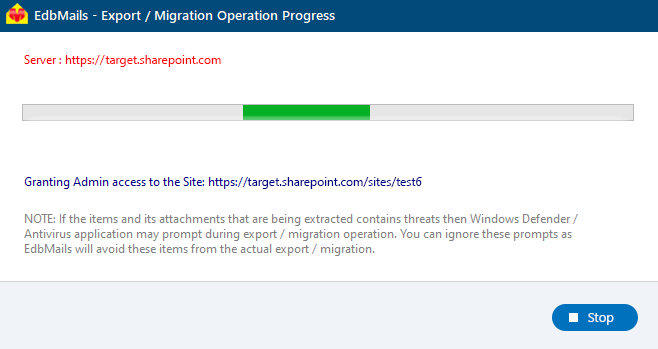
        Granting target Admin access progress

      • Once permissions are granted to the selected sites, a confirmation message will appear.

        Admin access granted  successfully

      • If you want to manually grant the admin access, refer to the link below:

          Steps to add Global admin as a member of each SharePoint site on the target server.

      • Select one of the authentication methods and click the ‘Login’ button to continue.
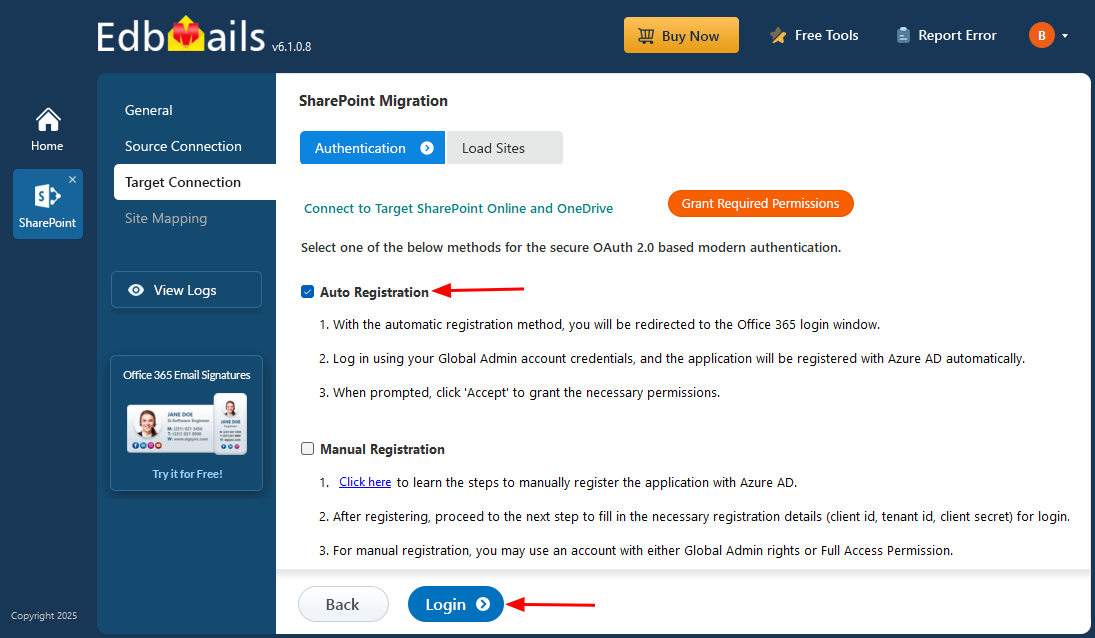
        Login to the target SharePoint server

         If you want to manually register the EdbMails application in Azure Active Directory (AD), click here for the steps.

      • Select one of the methods to load the SharePoint Sites. If you have additional sites that are not listed you load the sites using .CSV file.
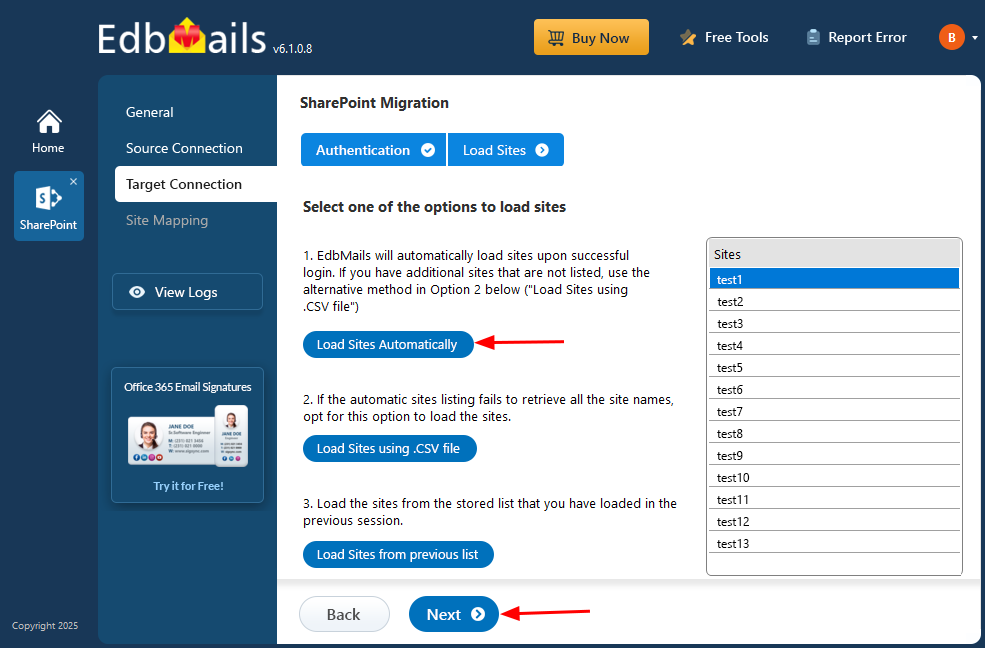
        Select option to Load Mailboxes


    • Step 5: SharePoint Source and target sites mapping

      • Select an option to map the sites between the source and the target SharePoint servers.
      • EdbMails Automatically maps the sites between the source and the target servers. You can also manually map the sites or select the option to map using previous migration mapping.
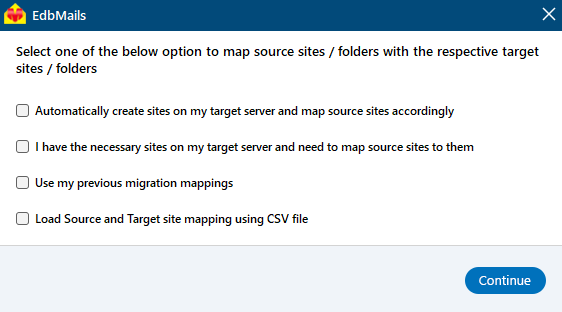
        choose required mapping options


    • Step 6: Start SharePoint Migration

      • Verify the sites mapping between the source and target SharePoint servers, then click the ‘Start Migration’ button to initiate the migration.
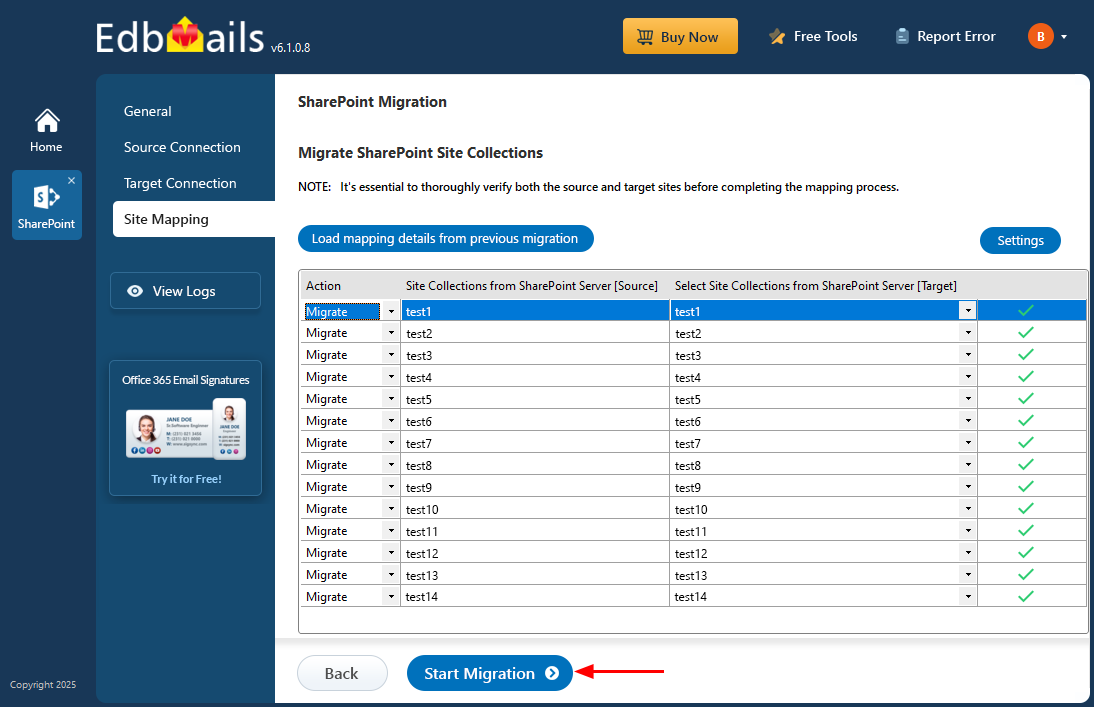
        Click Start Migration


      • During the migration, you can monitor the progress in real-time. Once the process is complete, a message will appear prompting you to review the migration status.
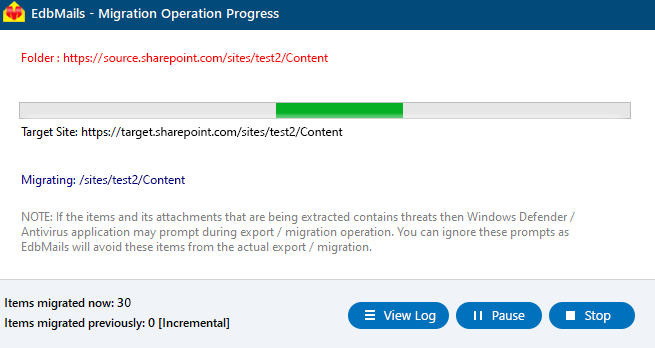
        SharePoint Migration Progress


      • Once the migration is complete, click the ‘View Logs’ button to view a detailed status of the migration process.

SharePoint Migration Best Practices

  1. Before initiating the migration process, carefully plan and analyze your SharePoint environment to identify critical components, dependencies, and potential risks.
  2. Take the opportunity to declutter and organize your SharePoint data before migration. Remove redundant, obsolete, or outdated content to streamline the migration process and improve overall performance.
  3. Conduct thorough testing of the migration process using a test environment to ensure compatibility, data integrity, and functionality. Address any issues or discrepancies before performing the actual migration.
  4. EdbMails supports incremental migration features to migrate only the changed or new data during subsequent migration cycles. This helps reduce downtime and optimize bandwidth usage.
  5. Continuously monitor the migration progress and verify the integrity of migrated data. Address any errors or discrepancies promptly to ensure a successful migration.

Benefits of EdbMails software for SharePoint Migration

  1. EdbMails provides a user-friendly software interface to successfully migrate SharePoint sites data with minimum number of clicks
  2. No PowerShell scripts to achieve SharePoint migration
  3. EdbMails offers a cost effective SharePoint migration
  4. Automatic mapping of SharePoint sites between the source and the target servers.
  5. Support for secure modern authentication to connect to source and the target SharePoint server.
  6. Free 24x7 tech support to address any queries related to migration.

Additional resources:

  • SharePoint Migration Tutorial - Videos
  • SharePoint Migration - Pricing
  • SharePoint Migration - FAQs
  • OneDrive Migration
  • Microsoft Teams Migration
lady image

 In this manual

SharePoint Online MigrationPre-Migration ActivitiesSharePoint Migration StepsBest PracticesEdbMails Benefits

SharePoint Migration

Just 10 Sites $80 Only

Buy Now

Need help?

24/7 Customer support

Contact us on Live chat

Personalized Demo

Book a personalized demo

Still need help?

Email us / Call us

© 2026 Shifttocloud Inc. Privacy Policy | Terms of Use | GDPR | Security | Press Releases

hidden msg
Live Chat

Hi, May I help you?

Hide Chat Now