

Zoho Mail to Gmail Migration
Planning a switch from Zoho Mail to Gmail? You’re not the only one. Zoho Mail is widely used for both personal and business communication and includes built-in productivity tools such as CRM, project management, and contact handling. However, many users are switching to Gmail because of its simplicity, smooth performance, and powerful capabilities. With more than 1.5 billion users worldwide, Gmail stands out for its user-friendly interface, strong spam protection, 15 GB of free storage, and easy integration with Google Workspace applications.
Migrating to Gmail is more than simply changing your email service - it’s about transferring to a smoother, more secure, and user-friendly communication platform. With features such as smart reply suggestions, powerful search capabilities, and integrated collaboration tools, Gmail provides a more efficient email experience. For users who need greater scalability, seamless access across devices, and consistent performance, migrating from Zoho Mail to Gmail provides a reliable and efficient solution.
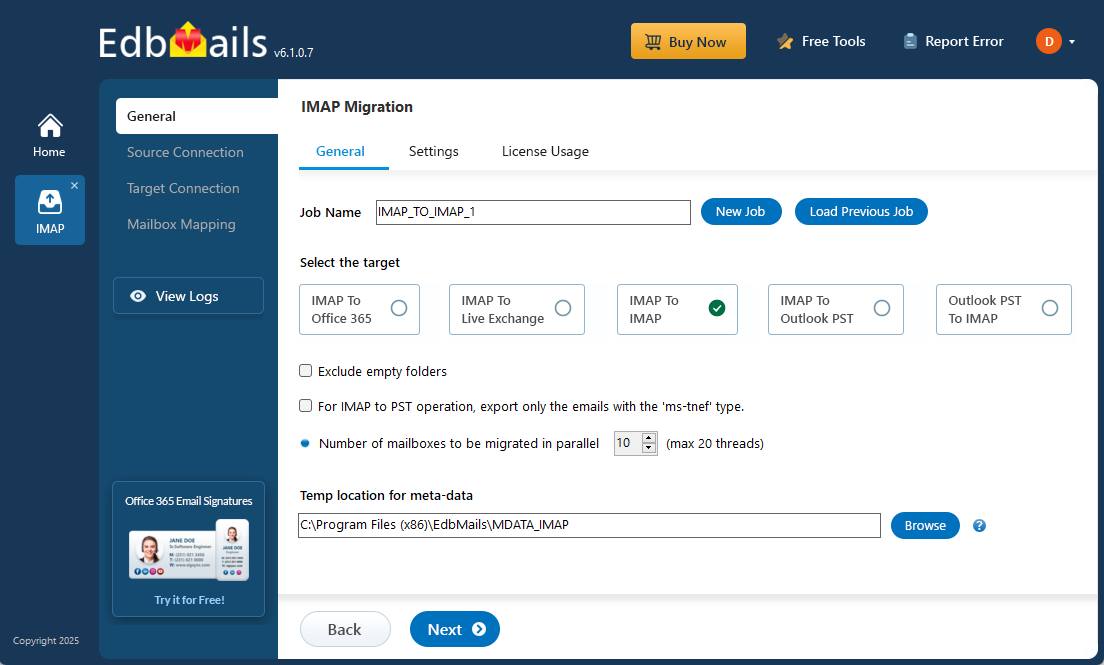
Migrating from Zoho Mail to Gmail may seem complex, but EdbMails IMAP migration software simplifies the entire process and ensures a smooth transition. With EdbMails, you can easily migrate important mail items such as emails, attachments, folders, and user data from Zoho Mail to Gmail while maintaining complete data integrity. A key advantage of EdbMails is its granular migration option, which enables you to choose specific emails or folders for migration, helping save both time and effort. The software also preserves important metadata such as timestamps, folder hierarchy, and read or unread status, ensuring that your mailbox data remains unchanged. Additionally, EdbMails supports direct migration by securely connecting your Zoho Mail and Gmail accounts, allowing a reliable and uninterrupted transfer of data.
EdbMails simplifies the entire process with a step-by-step wizard that guides you through each stage with clear and easy instructions, making it accessible even for non-technical users. In addition, 24/7 free technical support ensures expert help is always available whenever required, helping you complete the migration smoothly and successfully from beginning to end.
Reasons to Migrate from Zoho to Gmail
There are various factors that drive users to migrate from Zoho to Gmail. Here are some of the notable reasons behind this migration:
- User-Friendly Accessibility: Gmail offers a more intuitive and user-friendly interface compared to Zoho Mail, making it easier for users to navigate, search for emails, and manage their accounts efficiently.
- Ample Storage Capacity: Gmail provides significantly larger storage space compared to Zoho Mail, allowing users to store a larger volume of emails, attachments, and other data without the need to constantly manage and delete old messages.
- Advanced Email Features: Gmail offers advanced features such as IMAP, POP, and email forwarding options, providing users with greater flexibility in accessing and managing their emails. These features are not as comprehensive or readily available in Zoho Mail.
- Reliable File Handling: While Zoho Mail users may encounter occasional issues with file forwarding or acceptance, Gmail users generally experience smoother and more reliable file transfer processes, ensuring seamless communication.
- G Suite Integration: Gmail seamlessly integrates with the G Suite productivity tools offered by Google, including Google Docs, Sheets, Calendar, and more. These integrated services enhance collaboration and productivity, which are not available in Zoho Mail.
Planning to Migrate email from Zoho to Gmail
- Assess your specific needs, including the number of users, data volume, and desired migration timeframe.
- Create a Gmail account or G Suite subscription, depending on your requirements. Configure the necessary settings and ensure that your Gmail account is ready to receive the migrated data.
- Configure IMAP migration settings: If you opt for an IMAP migration tool, configure the necessary settings, such as providing the source Zoho Mail server details, target Gmail server details, authentication credentials, and migration options.
- Before migrating all data, perform a test migration to ensure that the process works smoothly. Verify that emails, contacts, and other data are successfully transferred from Zoho to Gmail.
- Inform all users about the upcoming migration. Provide instructions on how to access their new Gmail accounts and any necessary setup steps.
- Once you have completed the necessary preparations and testing, initiate the full migration process. Monitor the progress to ensure that all data is transferred correctly.
- After the migration, carefully review the migrated data in Gmail to ensure that everything is intact and accurately transferred. Cross-check emails, contacts, and other important information to confirm their completeness.
- Once you have verified the successful migration and ensure data integrity, you can proceed to decommission your Zoho Mail accounts.
Pre-migration activities to Migrate email from Zoho to Gmail
- Make sure that IMAP settings are enabled on both the source (Zoho) and target (Gmail/G Suite) servers.
- Keep a record of the email addresses and passwords for all the users you intend to migrate from the Zoho server.
- Ensure that you have the email addresses for all the users on the Gmail platform. Create an app password for the Gmail account.
Click here for the steps to create an app password for a Gmail account.
Steps to Migrate email from Zoho to Gmail
Step 1: Download and install the EdbMails software
- Download and install EdbMails on your computer.
See EdbMails system requirements for Zoho to Gmail migration
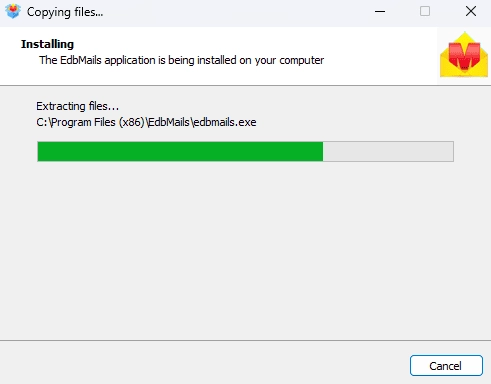
- Open the EdbMails application on your system.
- Enter your registered email address and password, then click ‘Login’. If you are using EdbMails for the first time, select ‘Start Your Free Trial’ to continue with the trial version.Note: The trial version includes all major features and allows migration of up to 30 items per folder. To perform unlimited migrations, purchase an IMAP Migration license from the official EdbMails website.After purchasing the license, close the application and open it again. Then sign in using the same email address and password used during the purchase to activate the license successfully.
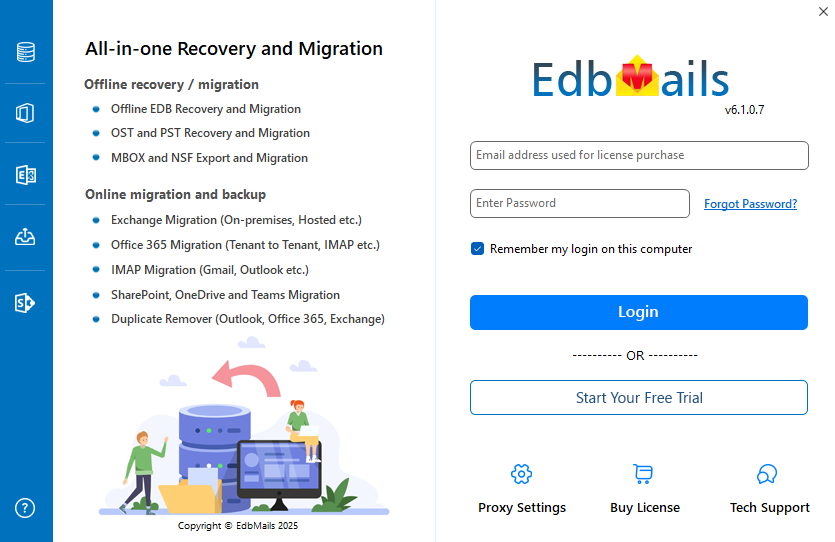
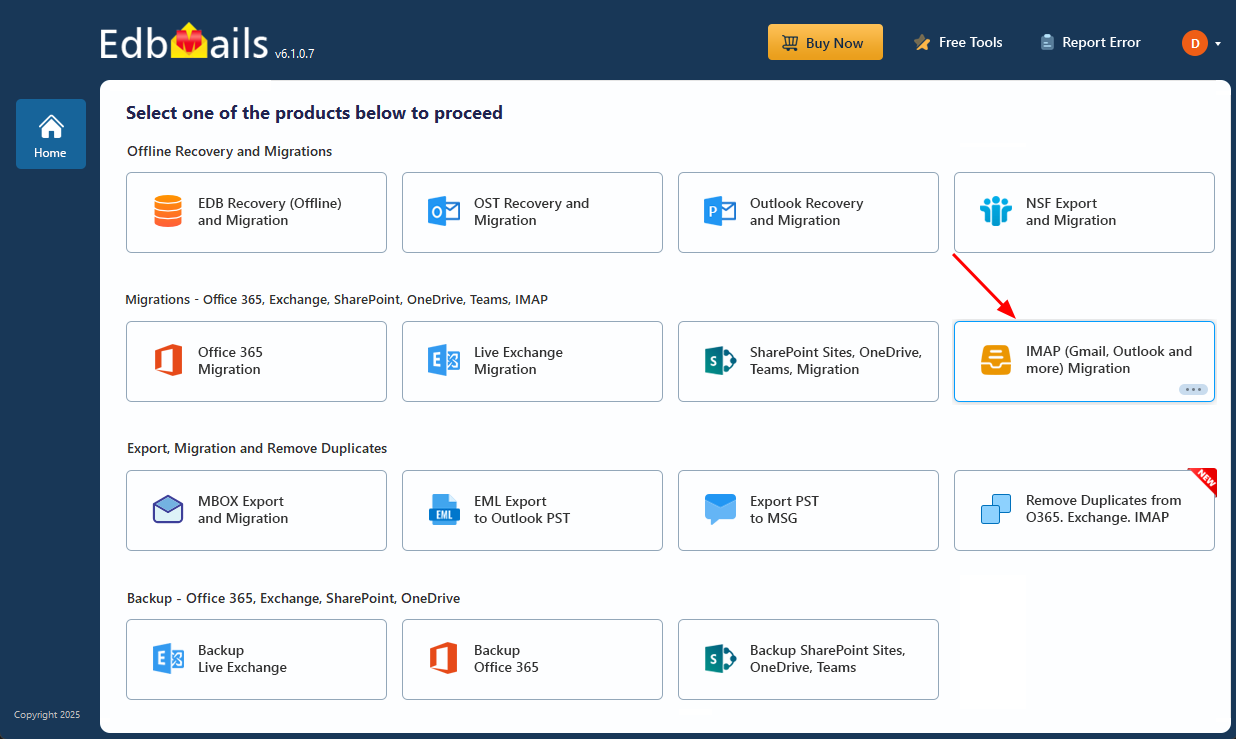
- Select the ‘IMAP (Gmail, Outlook & more) Migration’
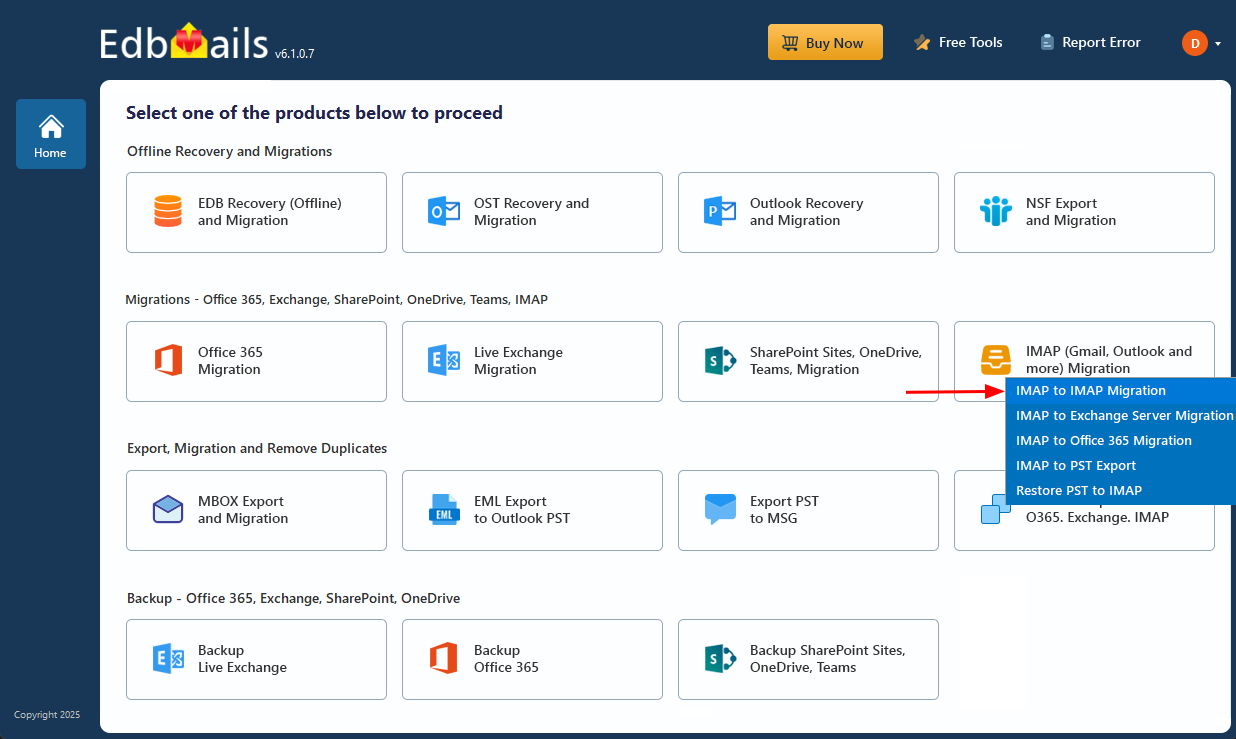
- Select ‘IMAP to IMAP Migration’.
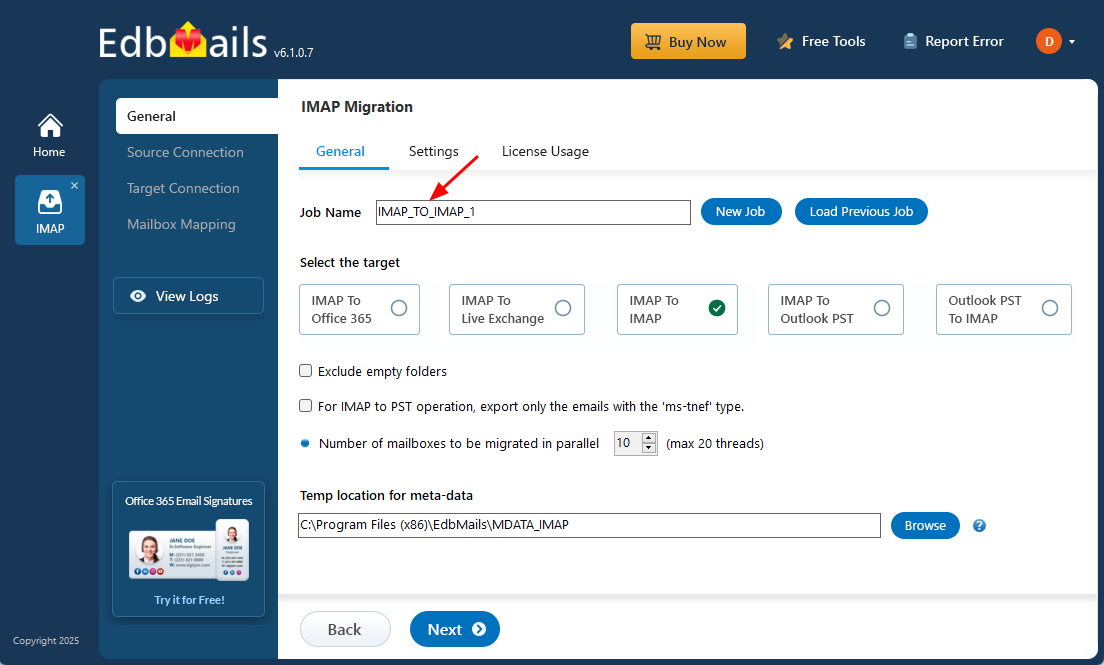
- Proceed with the default job name or click ‘New Job’ to assign a custom name for easier identification before continuing.
- Download and install EdbMails on your computer.
Step 2: Connect to the source Zoho Mail server
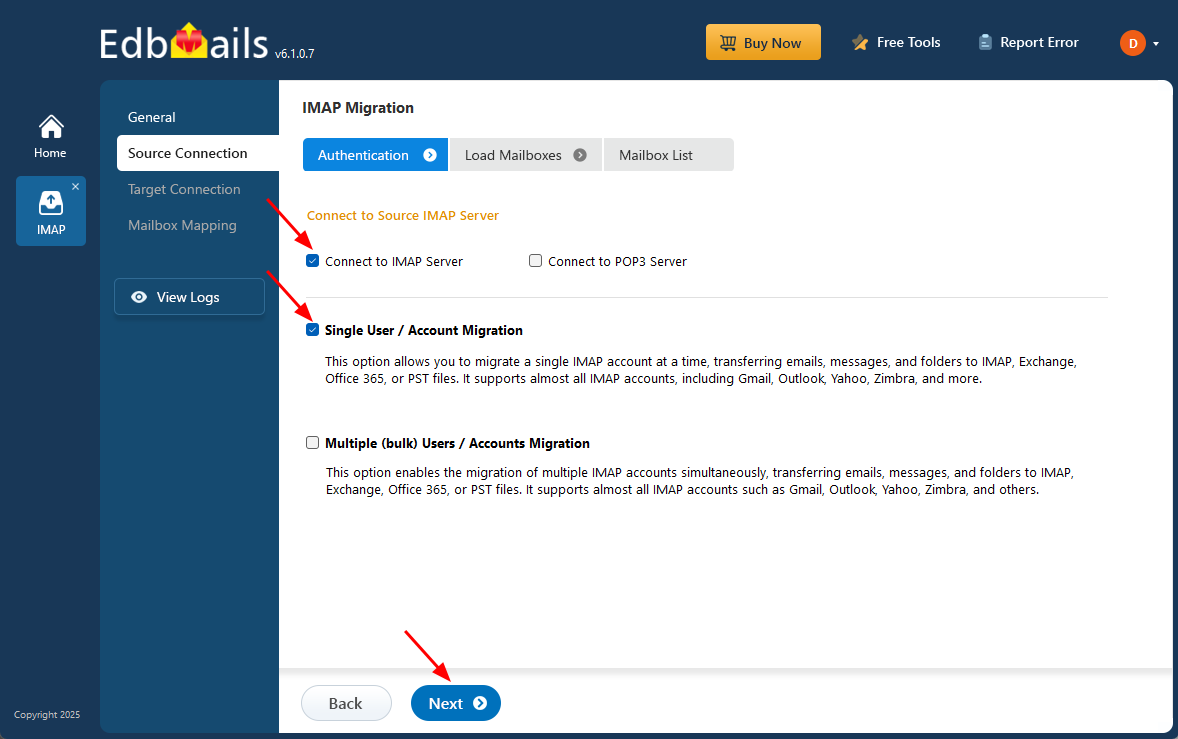
- To connect a single Zoho account for migration, click ‘Single User / Account Migration’, choose the suitable connection option such as ‘Connect to IMAP Server’ or ‘Connect to POP3 Server’.
- Click ‘Next’ to proceed.
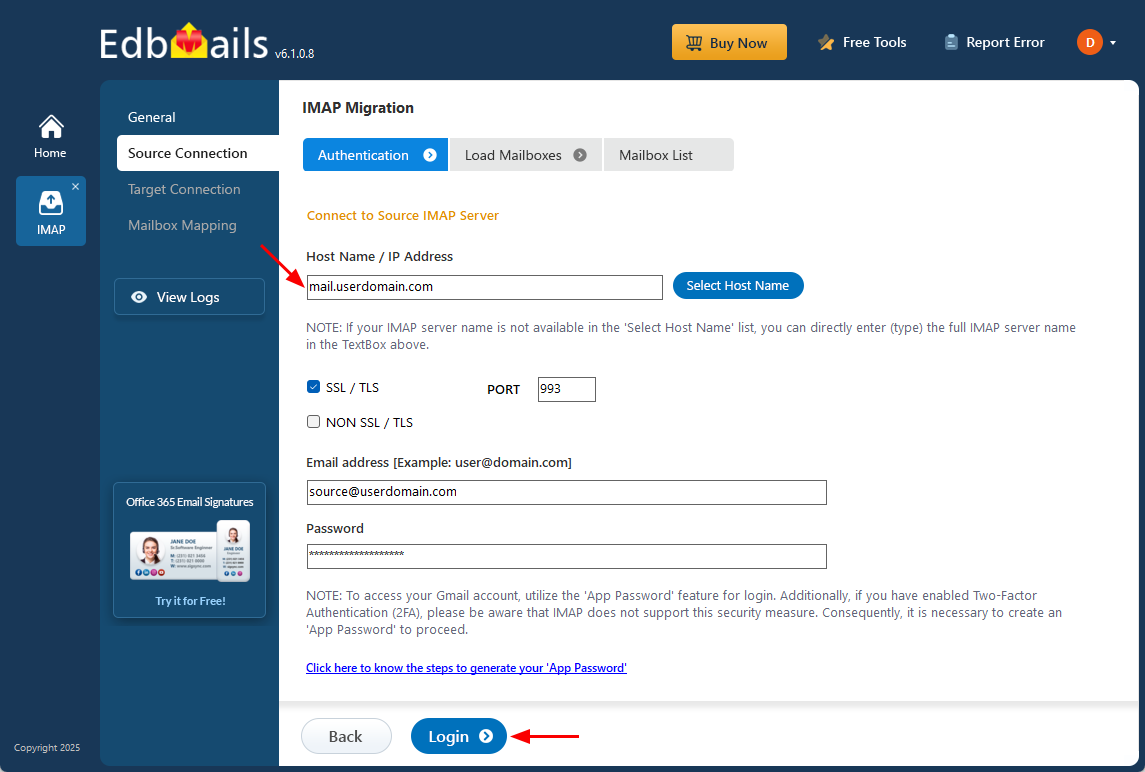
- Select the appropriate IMAP host name for your Zoho server from the list, or manually enter it if it’s not available. In most cases, the hostname will be in the format mail.userdomain.com, and if needed, you may also use the server’s IP address.
- For IMAP connections, select port 993 and make sure SSL/TLS encryption is enabled to ensure a secure connection. Then enter the email address and password of your source account to connect successfully.
- EdbMails does not save or store your credentials and relies on secure OAuth 2.0 authentication when logging in to Office 365.
- Click the ‘Login’ button to proceed.
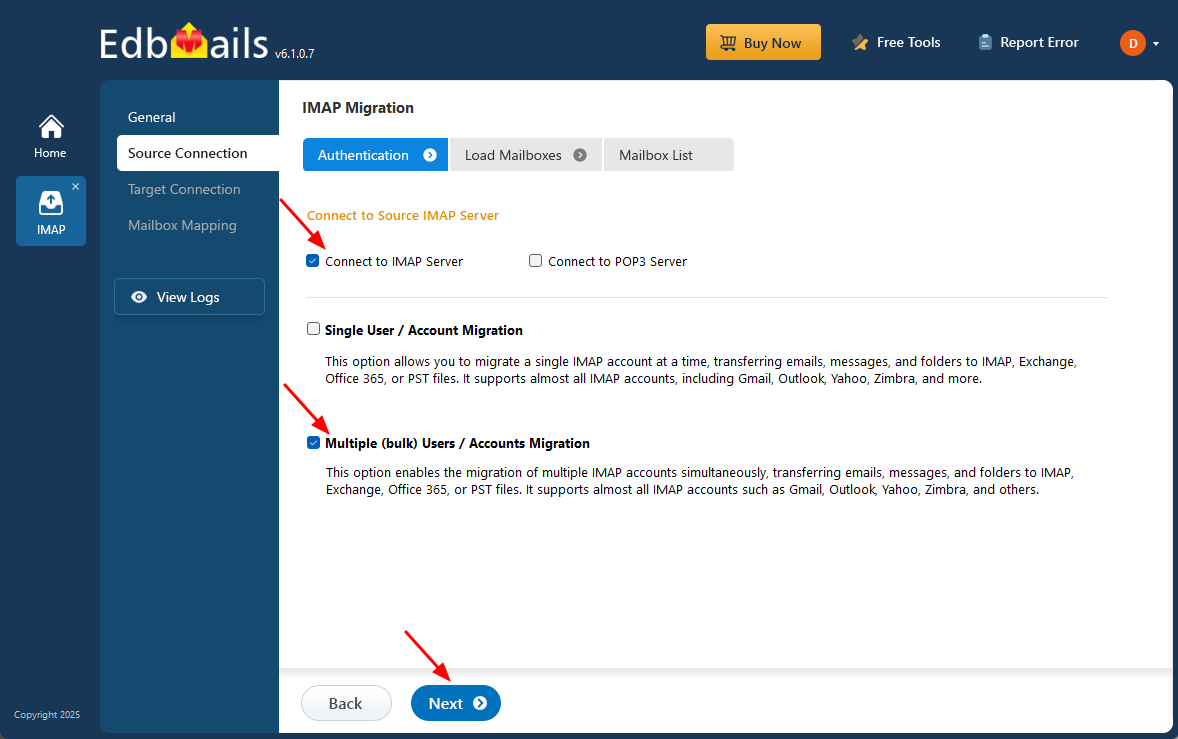
- For migrating multiple Zoho mailboxes simultaneously, choose ‘Multiple (Bulk) Users/Accounts Migration’, then select the appropriate connection option such as ‘Connect to IMAP Server’ or ‘Connect to POP3 Server’.
- Click ‘Next’ to continue.
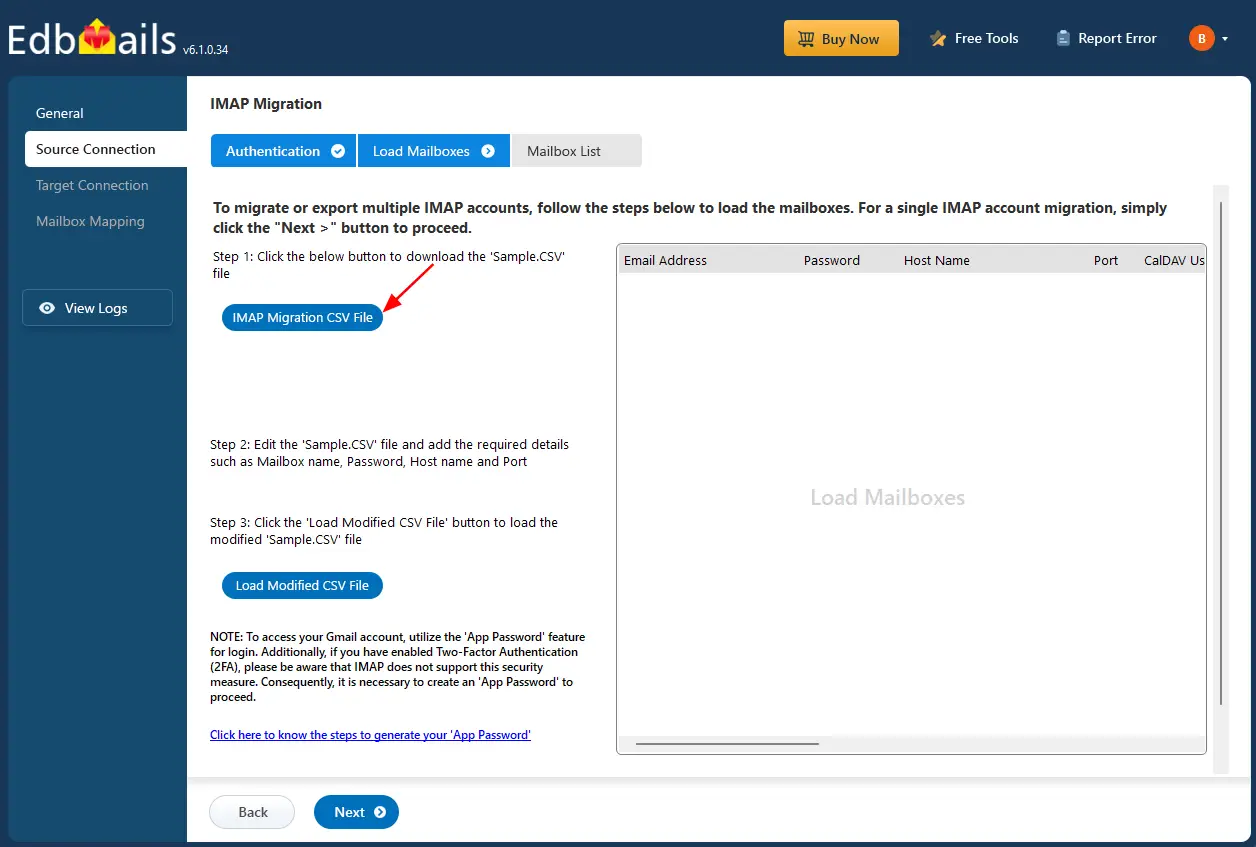
- Choose the ‘IMAP Migration CSV File’ option to download the ‘Sample.CSV’ file, which will be automatically saved to your local drive for future use and reference.
- Open the CSV file and enter the required information for each mailbox, such as the email address, password, IMAP server hostname, and port number. Once all the details are correctly filled in, save your changes and close the CSV file to continue with the migration process.

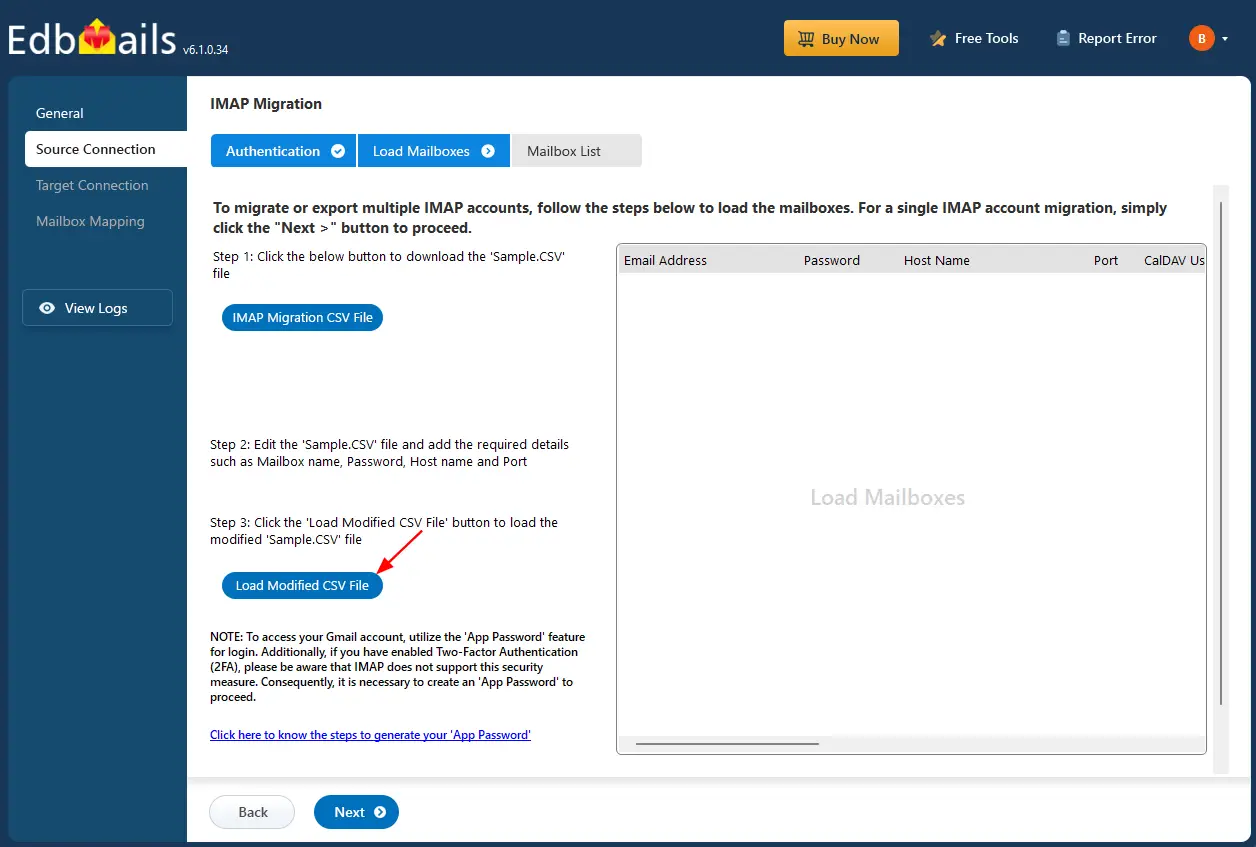
- Now, click the 'Load Modified CSV File' button, open the CSV file and click ‘Next’ to proceed.
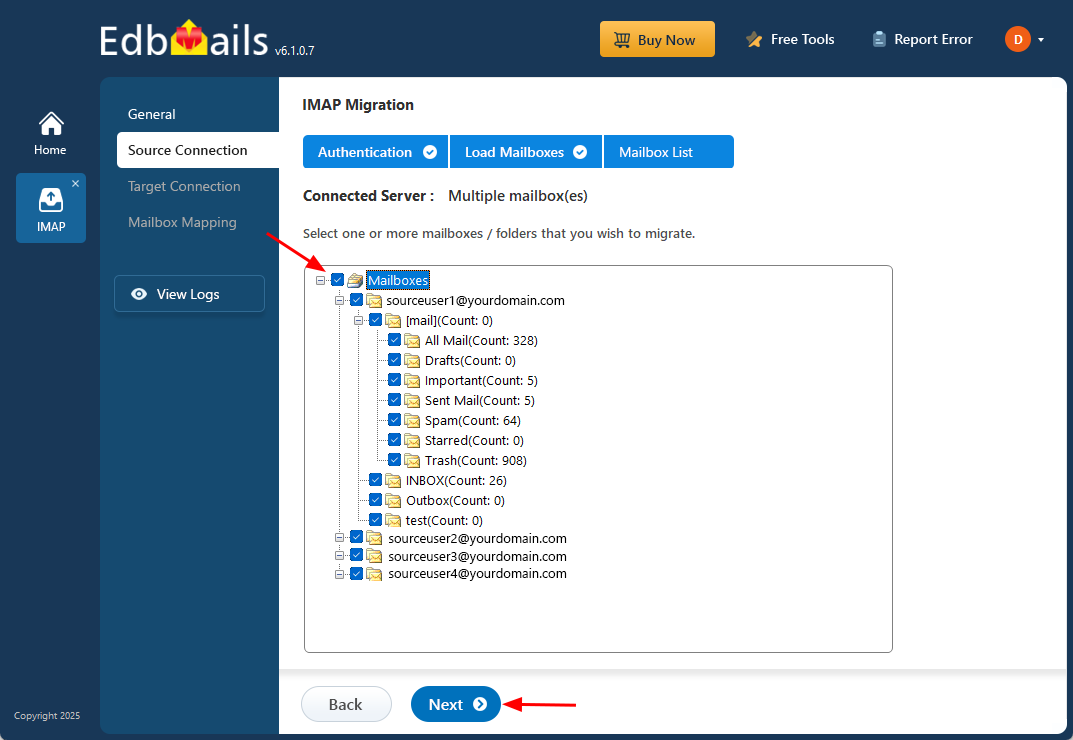
- Select the mailboxes or specific folders you want to include in the migration. After finalizing your selection, click ‘Next’ to proceed with the process.
Step 3: Connect to the target Gmail server
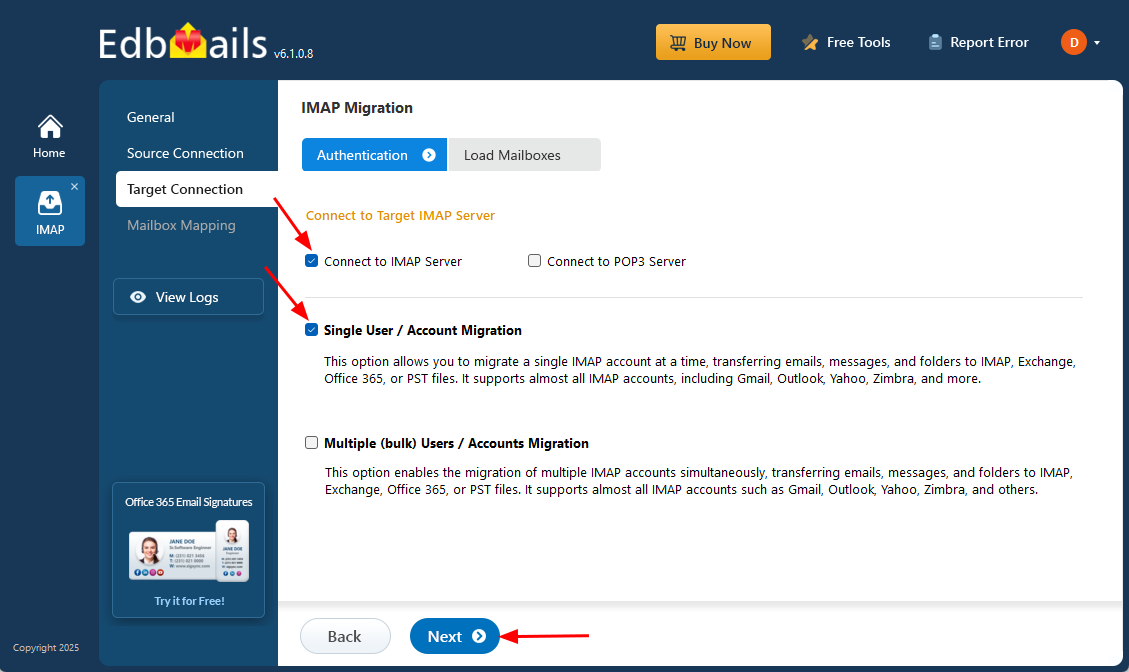
- To connect a single user account, select ‘Single User / Account Migration’. Then, choose the required protocol, such as ‘Connect to IMAP Server’ or ‘Connect to POP3 Server’, and click ‘Next’ to proceed.
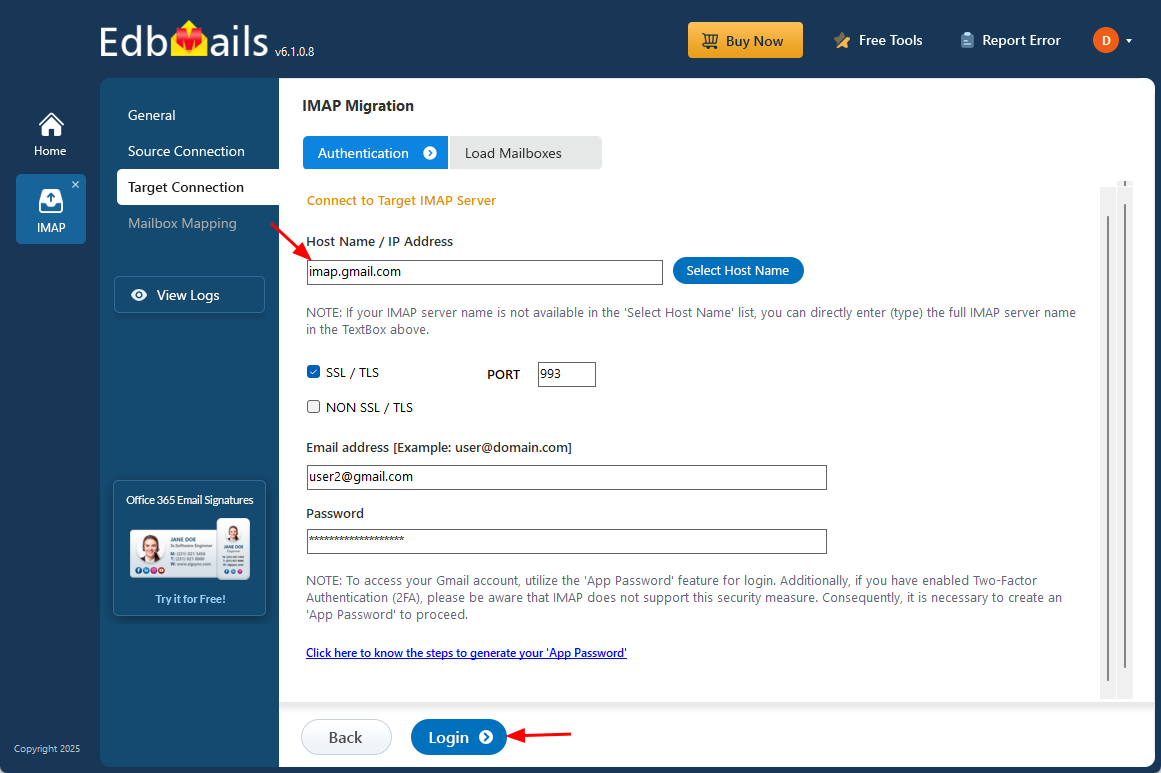
- For a single-user login, select the appropriate Zoho IMAP host name from the list or enter it manually (for example, mail.userdomain.com).
- Enter the email address and password in the required fields.
- If you are adding a Gmail account, generate an app password and use it in place of your regular account password.
- Click the ‘Login’ button.
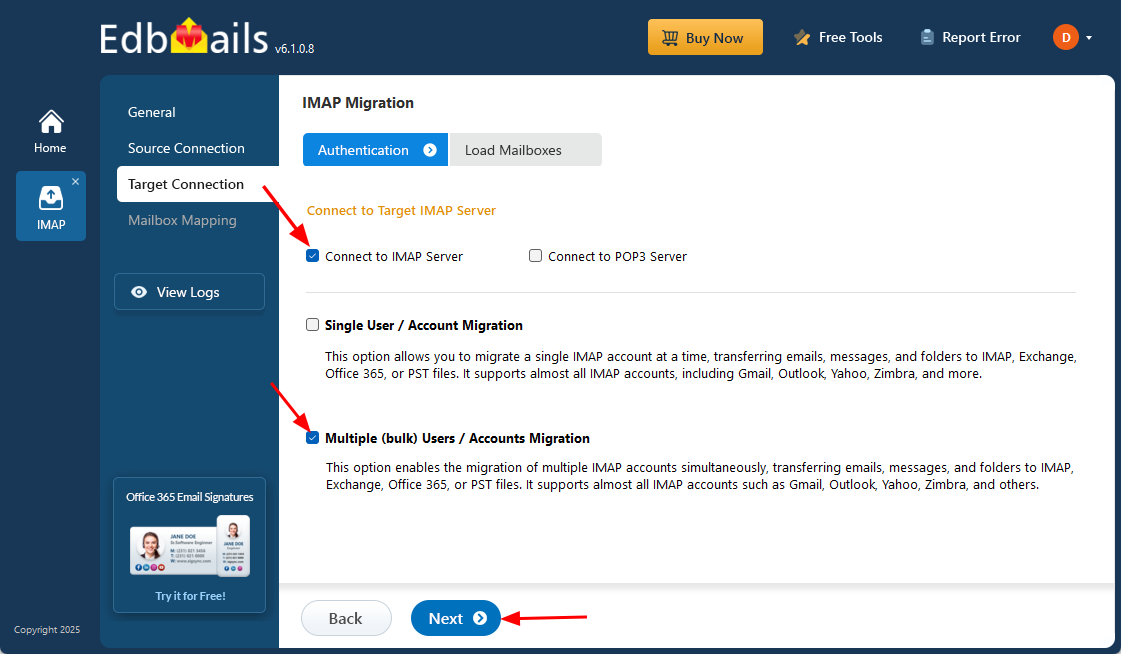
- For migrating multiple mailboxes, select ‘Multiple (Bulk) Users/Accounts Migration and click ‘Next’.
- Click ‘IMAP Migration CSV File’ to automatically download a sample CSV template to your computer for entering mailbox details.
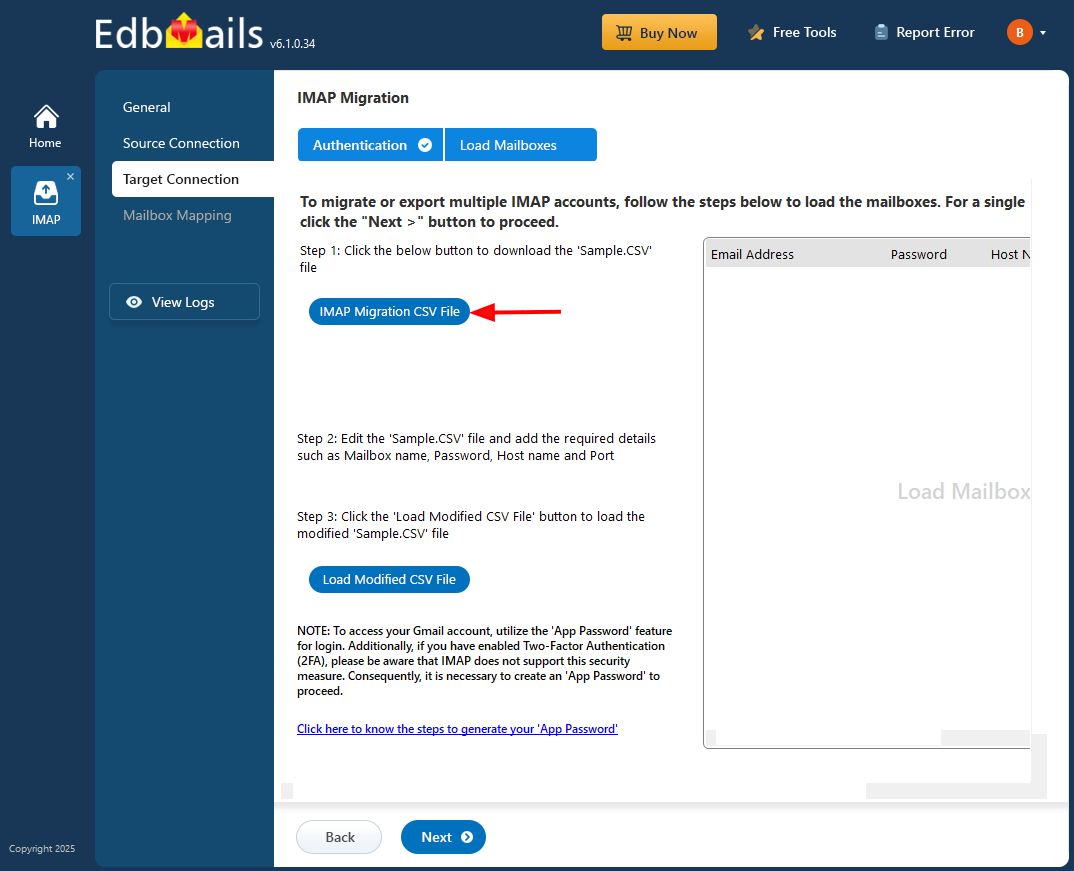
- Open the CSV file and fill in the necessary details, including the email address, password, IMAP server hostname, and port number for each mailbox. After completing the entries, save the file to proceed with the migration.

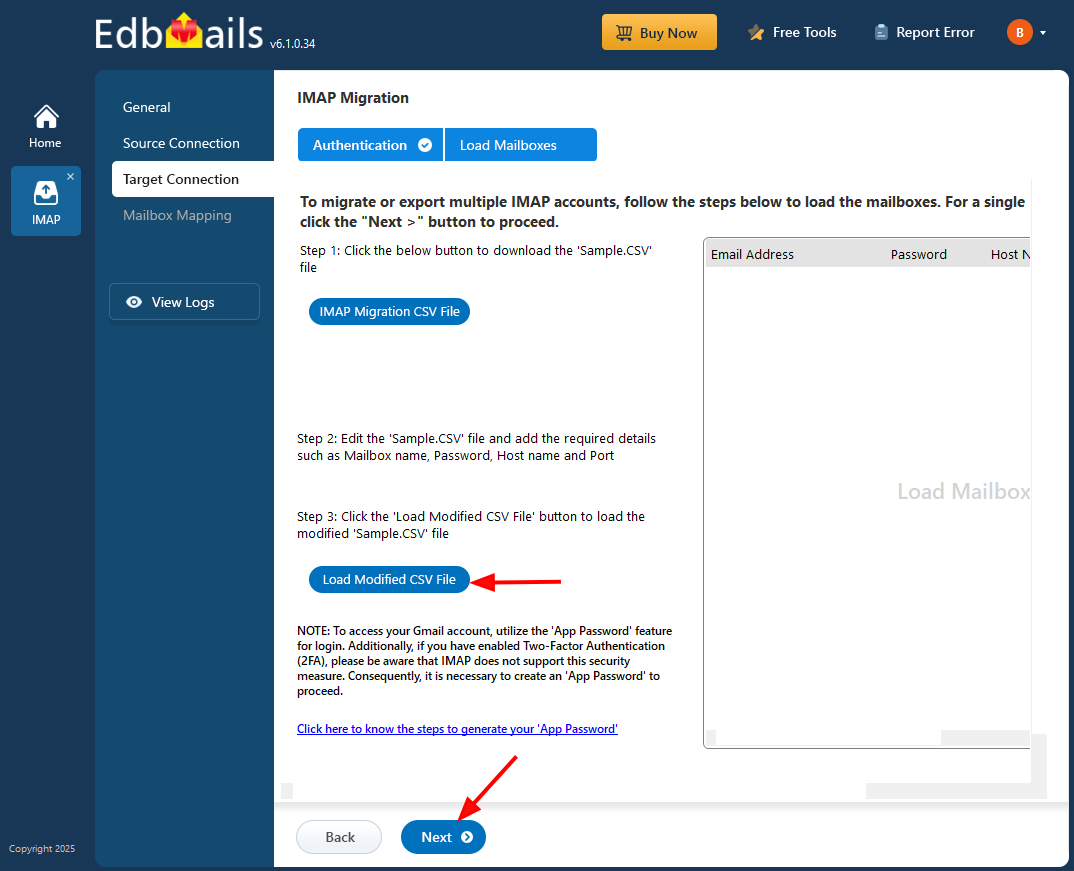
- Once completed, save the CSV file to apply the changes.
- Then, click the 'Load Modified CSV File' button, open the CSV file and click ‘Next’ to proceed.
- To connect a single user account, select ‘Single User / Account Migration’. Then, choose the required protocol, such as ‘Connect to IMAP Server’ or ‘Connect to POP3 Server’, and click ‘Next’ to proceed.
Step 4: Zoho Mail to Gmail mailboxes mapping
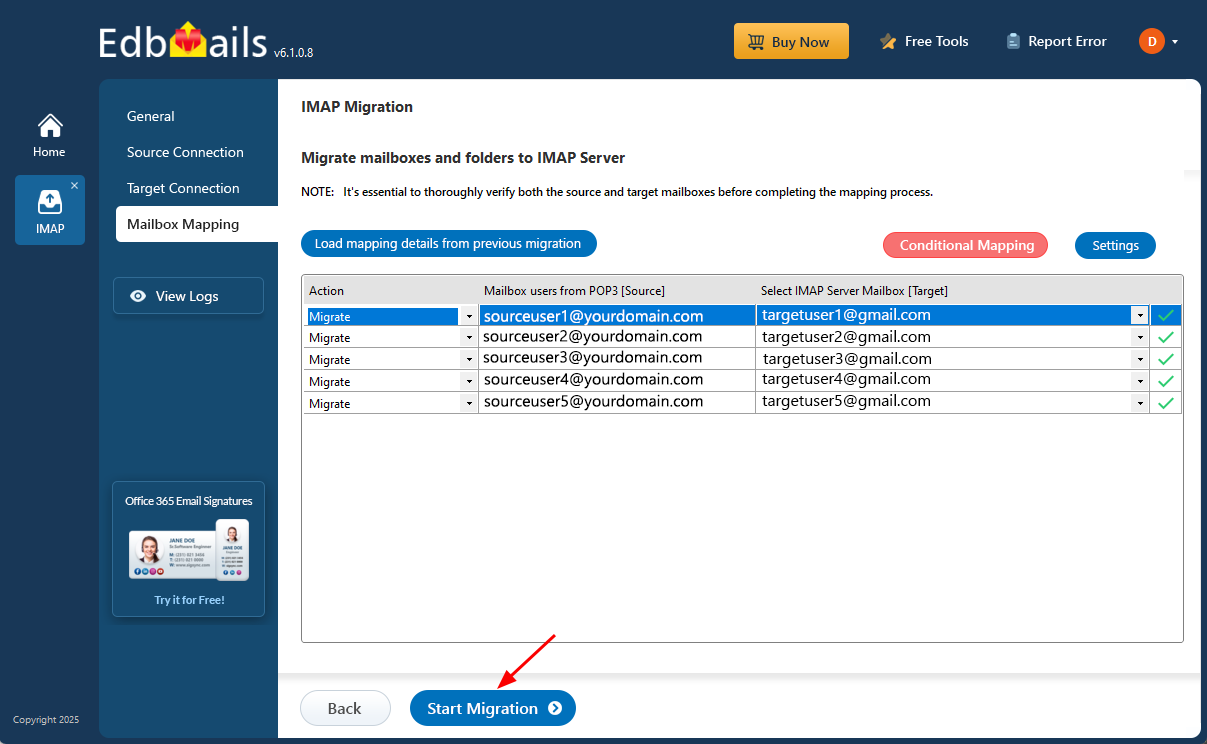
- Choose the suitable mailbox mapping method to align source mailboxes with their corresponding Gmail accounts. Opt for automatic mapping for convenience or manual mapping for greater control.
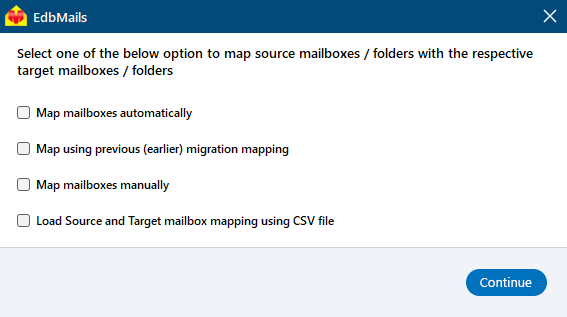
- EdbMails automatically maps source and target mailboxes. You can also manually map the mailboxes.
- Choose the suitable mailbox mapping method to align source mailboxes with their corresponding Gmail accounts. Opt for automatic mapping for convenience or manual mapping for greater control.
Step 5: Start Zoho to Gmail migration
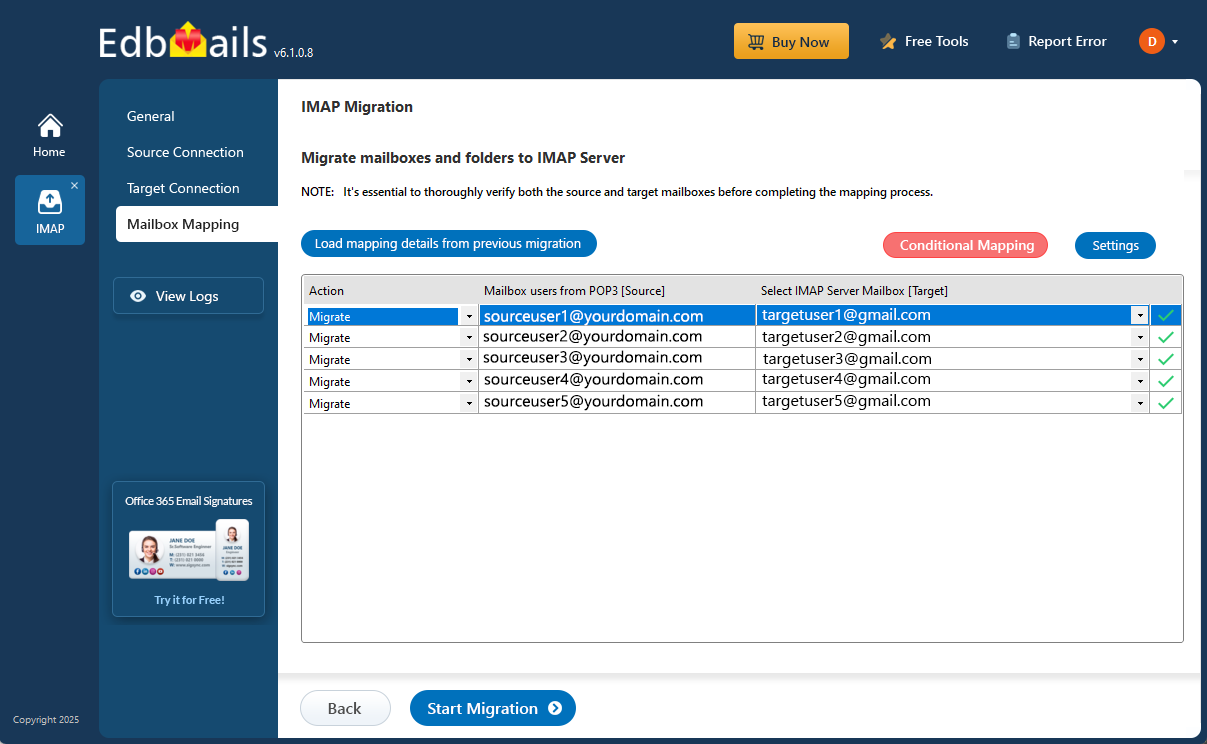
- Verify the mailbox mapping.
- Click the ‘Settings’ button to apply the filters. For example, you can set a date filter to migrate only the data within a certain date range.
- Click the ‘Start Migration’ button and initiate the migration process.
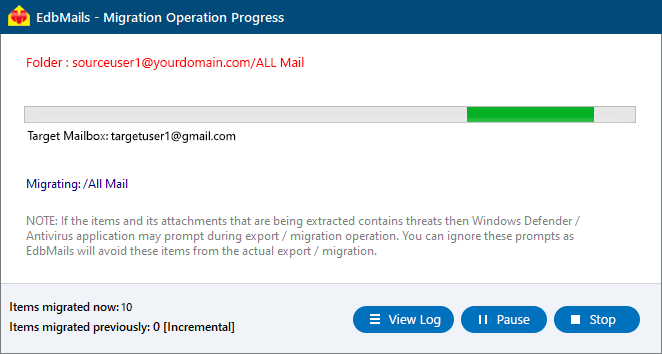
- To view the migration report, click the ‘View Logs’ button. It provides a comprehensive summary showing the number of emails, folders, and mailbox items migrated, along with their respective counts.
Zoho Mail to Gmail post-migration tasks
- Step 1: Updating MX Records
In order to redirect incoming email traffic to Gmail instead of Zoho, you will need to make adjustments to the MX records in your DNS provider's portal. This crucial step ensures that emails are correctly routed to your Gmail account, ensuring smooth communication.
- Step 2: Configuring AutoDiscover (CName)
To facilitate the automatic configuration of email clients and ensure a seamless transition to Gmail, it is important to include the AutoDiscover (CName) setting in your DNS configuration. By correctly configuring this setting, email clients can effortlessly connect to the Gmail server without the need for manual configuration.
- Step 3: Setting up Zoho Mail Forwarding
To avoid any email loss during the migration process, it is vital to set up mail forwarding in your Zoho account. This ensures that any incoming messages are forwarded to your Gmail account until the transition is fully completed. By enabling mail forwarding, you can remain connected and receive all your emails without interruption throughout the migration period.
- Step 1: Updating MX Records
Troubleshooting guide to Migrate email from Zoho to Gmail
For common migration issues, check the knowledge base articles. For more information on EdbMails IMAP migration, visit the frequently asked questions section or contact our support team.
Benefits of EdbMails to Migrate email from Zoho to Gmail
EdbMails offers a range of benefits that make it an excellent choice for users seeking to migrate their email data. Here are the key advantages of using EdbMails for Zoho Mail to Gmail migration:
- Comprehensive Migration: EdbMails provides a comprehensive solution for migrating email data from Zoho to Gmail. It can migrate all mailbox items, including emails, folders, subfolders ensuring a complete and seamless transition.
- User-friendly Interface: The tool offers a user-friendly interface that makes it easy to navigate and perform migration tasks. The intuitive design ensures that even users with limited technical knowledge can effectively use the tool.
- Automation and Efficiency: EdbMails automates the migration process, eliminating the need for manual intervention. You can connect to multiple mailboxes, saving valuable time and effort. The automated mapping feature intelligently maps the mailboxes and folders between Zoho and Gmail, ensuring a smooth transition of data.
- Data Integrity and Security: EdbMails ensures the integrity and security of your email data during Zoho Mail to Gmail migration process. It maintains the hierarchy of folders and subfolders, preserves email attachments, and migrates data without any loss or corruption. The tool also uses secure protocols for data transfer, ensuring the privacy and confidentiality of your sensitive information.
- Verification and Monitoring: The application generates detailed reports that allow you to verify the migrated items, including emails, folders, and mailbox items. You can monitor the migration progress in real-time, track any errors or issues, and take appropriate actions if needed.
- Flexibility and Customization: The tool offers flexibility and customization options to meet your specific migration requirements. You can choose to migrate selective folders or specific date ranges to streamline the migration process. Additionally, EdbMails allows you to pause and resume the migration at any time, giving you full control over the process.
- Technical Support: EdbMails provides reliable Free 24/7 technical support to assist users throughout the migration process. The support team is available to answer queries, troubleshoot issues, and ensure a successful migration experience.
- Cost-effective Solution: EdbMails offers cost-effective pricing plans that cater to different user needs. By providing a reliable and efficient migration solution, it helps users save both time and money compared to manual migration methods or other migration tools.
Frequently Asked Questions (FAQ)
Can I migrate selective folders only?
Does EdbMails preserve read/unread status?
Is there any downtime during migration?