


OST File Corruption: Causes and Fixes
There are several reasons that may make the Outlook data inaccessible, like server failure, accidental deletion of the mailbox, oversized OST files or synchronization errors. In such cases, the OST file (which contains data for the offline mailbox) may become orphaned or corrupted, and the important emails, attachments, and other mailbox items may become inaccessible. Such disruptions can stop everyday activities and threaten sensitive information.
EdbMails OST to PST Converter is a safe and secure method that helps you get access to your Outlook data. It allows you to convert OST to PST format successfully with the original file structure, email formatting, and original hierarchy of folders. EdbMails recovers all OST files, mailbox items, including emails, contacts, calendar, tasks, and attachments, etc. It can even recover corrupted OST files. You can also export the OST file to EML, HTML, and MHT formats or directly migrate to Office 365 & Exchange Server.
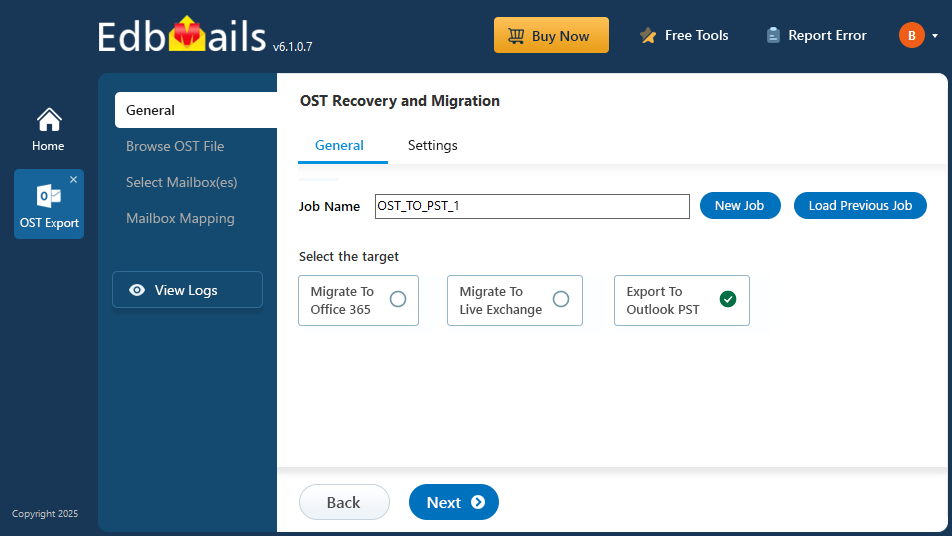
The following sections explain common causes of OST file corruption, outline the advantages of using EdbMails OST to PST Converter, describe how to repair damaged OST files, and provide an overview of key features along with answers to frequently asked questions.
Common reasons for OST File Corruption
There are many reasons for corruption of OST files. If this issue is not resolved on time, it may result in partial or complete loss of data. It is important to know the causes of corruption in order to choose the appropriate recovery approach. Here are some of the most common scenarios outlined below.
- In cases such as ransomware attacks, server crashes, or accidental deletion of mailboxes, the Exchange server may become permanently inaccessible. When this occurs, the corresponding Offline Storage Table (.ost) file becomes orphaned, and you cannot access mailbox data directly from Outlook.
- Problems with the Outlook installation, registry errors, or configuration issues can also disrupt access to the OST file. Such issues often result in errors like ‘Your Outlook data file could not be configured’. In cached Exchange mode, synchronization failures can cause folders not to sync properly, and corruption or inconsistencies in the Exchange database can also cause OST files not to be accessible or cause Outlook processes to end unexpectedly.
- Large or oversized OST files can affect the performance of Outlook. As the file size increases, Outlook may slow down or become unstable. Therefore, improving performance is necessary by exporting emails to a PST file on your hard drive for backup and long-term storage.
- OST files can also be corrupted because of network disconnections during OST sync, abnormal shutdowns of Outlook, or abrupt termination of Outlook processes. These interruptions can create file corruption, and you’ll have to recover and convert it to PST format.
- Also, accidentally deleted emails or folders from the Exchange server may still be there in the local OST file. You can export this data to a PST file for a backup copy of important items in your mailbox.
In all of the above situations, EdbMails lets you recover and convert OST files to PST file format, ensuring secure recovery, accessibility, and long-term backup of your Outlook data.
Why EdbMails is Best for Recovering Lost Outlook Emails
- EdbMails is the best choice for converting OST files to PST format, which comes with a full set of features that are intended to make the conversion process smooth and efficient.
- The software supports high-speed conversion with an easy-to-use user interface and provides 100% data security, so that the OST to PST conversion can be done quickly without any risk of data loss.
- But, SCANPST, the default data repair tool of Outlook, generally doesn't work with OST files and throws errors like 'Inbox Repair Tool does not recognize the file.ost' or 'SCANPST fails to repair OST file’.
- SCANPST is also limited to minor OST file corruption and cannot recover mail items when the Exchange mailbox is temporarily moved or unavailable on the server.
- EdbMails is a far more reliable solution to repair OST Files for Outlook versions 2021, 2019, 2016, 2013, 2010, and 2007.
- It is a full and reliable solution for all OST file repair and conversion needs, as it can recover and convert even severely corrupted OST files.
How to Repair the Corrupt and Damaged OST Files?
Microsoft Outlook does not open corrupted OST files. If you try to open or retrieve mail items from a corrupt OST file, you may get error messages like ‘Outlook OST file cannot be opened’ or ‘Errors have been detected in the OST file.’ In such cases, EdbMails is one of the best options to repair and convert corrupt or damaged OST files to PST format. It completely repairs OST files and allows you to recover and convert all mailbox data, like emails and other Outlook items.
How to repair the OST file and convert it to PST file?
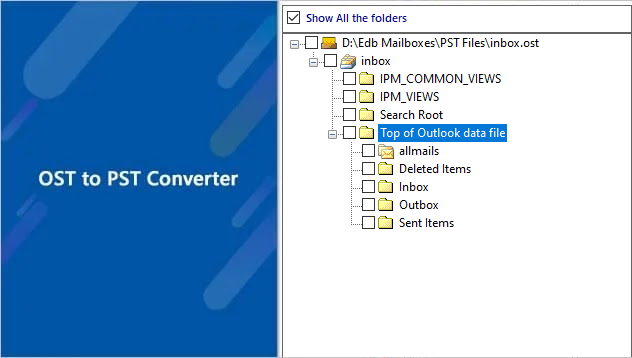
EdbMails OST to PST Converter Key Features
- User-Friendly Interface: EdbMails OST to PST Converter comes with a simple and user-friendly interface, allowing users of all experience levels to convert OST files to PST format easily.
- Fast Conversion: The tool helps to convert OST to PST within minutes for bulk OST files. It also offers the facility to split the OST file data into multiple PST files on OST to PST conversion for the effective management of large OST files.
- Safe and Secure: EdbMails OST to PST Converter ensures complete data security while converting Outlook data and also protects the mailbox content from unauthorized access or modification.
- Preview Feature: EdbMails lets you open the OST file and preview mailbox items such as emails, contacts, calendars, notes, tasks, journals, and header information before conversion.
- No Data Loss Conversion: The software performs the conversion of all Outlook mailbox items to PST format without any loss. Hence, 100% data integrity is maintained.
- Compatibility: EdbMails is compatible with all versions of Microsoft Outlook, including the latest Outlook 2022, ensuring wide compatibility in different environments.
Frequently Asked Questions
What is an OST file and how does it differ from PST files?
An OST (Offline Storage Table) file is a local copy of your Exchange mailbox that allows you to access and work on your emails even when you're offline. Once you're connected to the Exchange server again, any changes made while offline are automatically synchronized. OST files are automatically created when your Exchange mailbox is configured in Cached Exchange Mode in Microsoft Outlook, ensuring continuous access to your mailbox data.
A PST (Personal Storage Table) file, on the other hand, is a file format used to store copies of emails, contacts, calendars, and other data in Microsoft Outlook. Unlike OST files, PST files are not synchronized with an Exchange server and are typically used for archiving or backup purposes.
The key difference between OST and PST files is their function. OST files provide offline access to Exchange mailboxes and are created in Cached Exchange Mode, allowing users to work with their mailbox data without a direct server connection. PST files, however, are used for locally storing Outlook data, whether for archiving, backup, or keeping data that isn't linked to an Exchange server mailbox.
Does EdbMails fix OST file corruption?
How does EdbMails compare to ScanPST?
How long does it take EdbMails to convert an OST to a PST file?
Can I convert OST to PST for free with EdbMails?
How does EdbMails protect the data during the conversion process?
Can EdbMails convert password-protected OST files to PST format?
What is the largest OST file EdbMails can convert to PST?
Additional resources: