EdbMails EDB Recovery and Migration software
  • Products
    EdbMails
    All-in-one Recovery and Migration Tool
    • EDB recovery and Migration
    • OST, PST, MBOX, NSF, EML, MSG
    • Office 365, Exchange Migration
    • SharePoint, OneDrive & Teams
    • Google Workspace Migration
    • IMAP Migration
    • Duplicate Remover
    • EdbMails Data Recovery
    • Backup Solutions
    All Products

    EDB Recovery and Migration

    EdbMails lets you recover corrupted, damaged, and offline Exchange EDB files, convert EDB mailboxes to PST format, and directly migrate mailbox data to Office 365 and live Exchange Server.

    EDB to PST
    Recover corrupted, damaged, offline EDB files and convert Exchange EDB mailboxes to PST file format
    Public Folder to Exchange
    Migrate public folders from an Exchange offline EDB file to live Exchange Server
    EDB to Live Exchange Migration
    Directly migrate offline Exchange database (EDB) files to live Exchange server
    Archive Mailbox to Office 365
    Migrate archive mailboxes from offline EDB files directly to Office 365
    EDB to Office 365 Migration
    Directly migrate offline Exchange database (EDB) files to Office 365
    Public Folder to Office 365
    Migrate public folders from an offline Exchange EDB file to Office 365

    OST, PST, MBOX, NSF, EML, MSG Export and Migration

    EdbMails lets you to recover OST and PST files, export OST, PST, MBOX, NSF, EML, and MSG files to PST files, and directly migrate OST, PST, MBOX, and NSF mailbox data to Office 365 and live Exchange Server.

    OST Recovery and Migration
    Recover offline OST files, convert OST to PST, and migrate OST to Office 365 and Exchange Server
    PST Recovery and Migration
    Recover Outlook PST files , Export PST to PST, migrate PST to Office 365 and Exchange Server
    MBOX Export and Migration
    Export MBOX to PST, migrate MBOX to Office 365 and Exchange Server
    NSF Export and Migration
    Export NSF to PST, migrate NSF to Office 365 and Exchange Server
    EML to PST Export
    Convert EML files to Outlook PST files
    PST to MSG Export
    Convert Outlook PST file to MSG file format
    MSG to PST Export
    Export MSG files to Outlook PST files

    Office 365, Exchange Migration

    EdbMails lets you securely migrate mailboxes across Microsoft 365, Exchange, Google Workspace (G Suite), and IMAP-supported servers such as Outlook, Gmail, Zimbra, Zoho Mail, and cPanel, ensuring zero downtime.

    Office 365 Migration
    Migrate between Office 365 tenants, Office 365 to Exchange, Office 365 to PST, PST files to Office 365.
    Exchange Migration
    Migrate between any Exchange Servers, Exchange to Office 365, Exchange to PST, PST files to Exchange.
    Tenant to Tenant Migration
    Migrate Mailboxes, Public Folders, Archive Mailboxes between Office 365 Tenants.
    Exchange to Office 365
    Migrate Mailboxes, Public Folders, Archive Mailboxes from live Exchange server to Office 365.
    Office 365 to IMAP
    Migrate Office 365 to IMAP, Office 365 to Gmail, Office 365 to Outlook, Office 365 to Zoho etc.
    Exchange to IMAP
    Migrate from live Exchange Server to IMAP servers such as Gmail, Outlook, and Zoho Mail.
    Public Folder to Office 365
    Migrate Public Folders between Office 365 tenants with complete folder hierarchy and mailbox data integrity.
    Exchange to PST
    Export live Exchange Server mailboxes, public folders, and archive mailboxes to Outlook PST files.

    SharePoint, OneDrive & Microsoft Teams Migration

    EdbMails lets you migrate SharePoint sites, OneDrive data, Microsoft Teams, teams, channels, chats, permissions, and documents between Microsoft 365 tenants while maintaining the existing folder structure and data integrity.

    SharePoint Online Migration
    Migrate documents, lists, files and folders from SharePoint sites.
    OneDrive for Business Migration
    Migrate documents, lists, files, folders, private chats from OneDrive.
    Microsoft Teams Migration
    Migrate Teams, chats, channels, documents, files and folders etc.

    Google Workspace / G Suite Migration

    EdbMails offers secure Google Workspace migration to Office 365, Exchange, or IMAP, and export to PST covering emails, contacts, calendars and tasks.

    G Suite Migration
    Google Workspace Migration
    Migrate emails, calendars, contacts, tasks from Google workspace to Google workspace, office 365, Exchange and IMAP. Export to PST
    G Suite to Office 365
    Google Workspace to Office 365
    Migrate emails, calendars, contacts, tasks from Google Workspace / G Suite to Office 365
    G Suite to Exchange Server
    Google Workspace to Exchange Server
    Migrate emails, calendars, contacts, tasks from Google Workspace / G Suite to on-Premise Exchange Server
    G Suite to IMAP
    Google Workspace to IMAP
    Migrate emails, calendars, contacts, tasks from Google Workspace / G Suite to IMAP, Outlook, Zimbra, Zoho etc.
    Google Workspace to Google Workspace Migration
    Google Workspace to Google Workspace
    Migrate emails, calendars, contacts, tasks between two Google Workspace / G Suite tenants
    Google Workspace to PST
    Google Workspace to PST
    Export emails, calendars, contacts, tasks from Google Workspace / G Suite to Outlook PST files

    IMAP Migration

    EdbMails IMAP Migration tool lets you easily migrate emails from IMAP servers such as Outlook, Gmail, Zoho Mail, Zimbra, cPanel, and more. Supports IMAP to IMAP, Office 365, Exchange Server, PST, and bulk PST to IMAP migration.

    IMAP Email Backup & Migration
    Backup and migrate emails from IMAP servers to PST, Office 365, and On-Premises Exchange Server
    IMAP to Office 365
    Migrate emails, folders, and attachments from IMAP servers to Office 365
    IMAP to Exchange
    Migrate emails, folders, and attachments from IMAP servers to on-premises Exchange Server
    IMAP to PST
    Export emails, folders, and attachments from IMAP servers to Outlook PST files for backup
    PST to IMAP
    Migrate emails, folders, and attachments from bulk PST files to IMAP servers

    Duplicate Remover

    EdbMails Duplicate Remover lets you easily remove duplicate items from Office 365 and Exchange Server, and from IMAP, Outlook, Gmail, Zimbra, Zoho Mail, etc., ensuring a clean and organized mailbox.

    Remove Duplicates
    Easily clean up your Office 365, Exchange, Outlook and IMAP accounts by removing duplicate emails.
    Remove Duplicates from Office 365
    Remove duplicate emails, calendars, contacts, journal tasks, etc. from Office 365.
    Remove Duplicates from Exchange Server
    Remove duplicate emails, calendars, contacts, journal tasks, etc. from live Exchange Server.
    Remove Duplicates from IMAP, Outlook
    Remove duplicate emails, attachments from IMAP, Outlook, Gmail, Zimbra, Zoho Mail etc.

    Exchange, SharePoint, OneDrive, Teams and Office 365 Backup

    EdbMails enables secure, automated backup and recovery for Microsoft 365 services including Exchange Online, SharePoint, OneDrive, Teams, and Live Exchange Server with complete data protection and restore flexibility.

    Office 365 Backup
    Incremental, Granular, Encrypted and Compressed Office 365 Mailboxes Backup
    Exchange Server Backup
    Incremental, Granular, Encrypted and Compressed Exchange Mailboxes Backup
    SharePoint, OneDrive & Teams Backup
    Backup Online site collections, Team sites, Office 365 groups, all documents etc.

    EdbMails Data Recovery

    EdbMails Data Recovery Software lets you recover permanently deleted data, including photos, videos, documents, and archived files, from partitions on hard drives, SSDs, USB drives, SD cards, and external storage devices.

    EdbMails Data Recovery
    Recover and restore permanently deleted data from hard drives, SSDs, USB drives, SD cards, and etc.
    Whitepaper
    Request a Demo
    Sign Up
  • Features
  • FAQ
  • Offers
  • Pricing
  • Download
  • Support
  • Sign in
User’s Manual
Office 365 Migration

User Manual

User Manual

  • Office 365 Migration Overview
  • Initial setup
  • System Requirements
  • Migration Scenarios
  • Software Setup
    • EdbMails Installation Process
    • Upgrading the Software
    • How to uninstall
    • Reinstallation
  • Understanding the Application
    • Software's Main Components
    • Understanding the Migration
  • FAQ
    • General
    • Migration Free Trial / Demo
    • Migration License
    • Before Migration
    • Migration - Steps
    • After Migration
  • Videos
    • Office 365 to Office 365
    • Office 365 to Exchange
    • Office 365 to IMAP
    • Office 365 to PST
    • Public Folder to Office 365
    • Archive Mailbox to Office 365
    • Public Folder to Exchange
    • Archive Mailbox to Exchange
    • Restore Bulk PST files to Office 365
    • Automatically Create Office 365
    • Export Office 365 user to CSV file
  • Screenshots
    • Office 365 to Office 365
    • Office 365 to Exchange
    • Office 365 to PST
    • Office 365 to IMAP
  • How it works?
    • Office 365 to Office 365
    • Office 365 to Exchange
    • Office 365 to IMAP
    • Office 365 to PST
    • Public Folder to Office 365
    • Public Folder to Exchange
    • Public Folder to Shared Mailbox
    • Archive Mailbox to Office 365
    • Archive Mailbox to Exchange
    • Office 365 to Hosted Exchange
    • Multiple PST to Office 365
    • Office 365 to Gmail Migration
    • Office 365 Shared mailbox to Exchange
    • Office 365 Public folders to PST
    • Office 365 archive mailbox to PST
    • Office 365 Shared mailbox to PST
    • Office 365 shared mailbox to Public folder
    • Office 365 Archive mailbox to Shared mailbox
    • Office 365 Shared mailbox to Archive mailbox
    • Office 365 to Zoho migration
    • Office 365 group mailbox to shared mailbox
    • Shared mailbox to Office 365 Groups mailbox
    • Office 365 Groups mailbox to Regular mailbox
  • Connect to source Office 365
  • Connect to target Office 365
  • Modern Authentication Using OAuth 2.0
    • Microsoft 365 modern authentication
    • Automatic Registration
    • Manual Registration
  • Connect to Exchange server
  • Knowledge Base
    • What is Office 365 Migration?
    • Migrate between Office 365 tenants
    • Migrate Office 365 mailbox
    • Public folder migration
    • Office 365 Migration with same Domain
    • Office 365 Group Migration
    • Selective Mailbox Migration
    • Migration to Exchange 2007, 2010, 2013, 2016 and 2019
    • User-Defined Mailbox/Folder Mapping
    • Export Office 365 users to CSV
    • GoDaddy to Microsoft 365 migration
    • Rackspace to Office 365 migration
    • Office 365 migration methods
    • Office 365 migration checklist
    • Migrate Shared mailbox to Office 365
    • Office 365 migration best practices
    • Office 365 migration challenges
    • Convert shared mailbox to regular mailbox
    • Office 365 to Exchange 2019 migration
    • Office 365 multiple mailbox migration
    • Cross-Tenant Office 365 migration
    • EWS throttling in Exchange Online
    • Office 365 migration common use cases and solutions
    • Language settings on Office 365 Server
    • Office 365 to iCloud migration
    • Office 365 to Yahoo Mail migration
    • Microsoft 365 sign-in issue
    • Batch create Outlook profiles Intune
    • Create an Office 365 Migration Endpoint
    • Validate Office 365 Mailbox Migration
    • Office 365 Migration Network Requirements
    • Microsoft 365 Migration URLs & Endpoints
    • Office 365 Migration Firewall Ports
    • DNS Changes After Office 365 Migration
    • Autodiscover Troubleshooting After Migration
    • Post-Migration MX Record Validation
    • Office 365 Mail Flow Troubleshooting
    • Mailbox Permission Validation
    • EdbMails vs CodeTwo vs MigrationWiz vs Native Tools
    • Calendar Permission Migration Issues
    • Folder Permission Troubleshooting
    • Large Mailbox Migration Best Practices
    • Archive Mailbox Sync Issues
    • Office 365 Migration Coexistence
    • Cross-Tenant Mailbox Permissions
    • Cross-Tenant Calendar Migration
    • Migration Using App-Only Authentication
    • Office 365 Mailbox Mapping Errors
    • Exchange Online Migration Limits
    • Mailbox Integrity After Migration
    • Security Best Practices for Migration
  • Migration Types
    • Cutover Migration
    • Staged Migration
  • Set Exchange Server Impersonation rights
  • Map the Mailboxes
  • Migration Walkthrough
    • Office 365 tenant to tenant migration
    • Office 365 to PST Export
  • Multifactor Authentication
    • Enable MFA in Office 365
    • Create App password for MFA
    • Disable Security Defaults
  1. Home
  2. Office 365 Migration
  3. How to export Office 365 public folders to PST?
Download Buy Now

Export Office 365 Public Folders to PST

Public folders in Office 365 provide a shared data structure that organizations use to distribute email, calendar items, contacts, and related content across departments, without duplicating that data into individual user mailboxes. This centralized model works well for day-to-day collaboration, but it creates a specific challenge when that data needs to exist outside the live tenant. Regulatory retention requirements, offline backup policies, and platform migrations all call for the same outcome: public folder content exported into PST format, independent of the Office 365 environment.

The technical difficulty isn't the export itself, it's what the export has to account for. Public folders accumulate data over years of use, and by the time an export is initiated, the folder tree can include deeply nested subfolders, large attachment volumes, and permission sets scoped to individual users or security groups. Native Office 365 export functionality wasn't designed to handle this at scale; it enforces size and item-count limits, and it doesn't consistently preserve folder-level permissions in the output. When an organization needs to export more than a handful of folders, each with a different structure and size, the administrative overhead of doing this manually becomes significant.
Office 365 export public folders to PST

EdbMails Office 365 migration tool is designed to remove that overhead. It performs a single-pass export of public folder content, including emails, attachments, calendar items, contacts, tasks, and their associated permissions, without requiring PowerShell scripts or manual configuration on the admin's end. As a Microsoft-partnered application, it's built to work within Microsoft's supported integration methods rather than around them, which matters for organizations that need the export process to remain auditable and compliant.

From a data-integrity standpoint, EdbMails preserves folder hierarchy, timestamps, and metadata attributes exactly as they exist in the source environment, so nothing is restructured or altered during export. For larger public folders, EdbMails provides an option to split the output into smaller PST files, which reduces the likelihood of file corruption and keeps individual files easier to store, transfer, and open in Outlook. The export process also includes automatic throttling management to stay within Microsoft's API request limits, allowing large exports to run without degrading performance for other users on the tenant.

  1. Prerequisites for exporting Office 365 Public Folders to PST

    • Install Microsoft Outlook and configure an Outlook profile on the computer where the export will be performed.
    • Ensure sufficient free space on your drive to save the resulting PST file.
  2. Steps to Export Office 365 public folders to PST using EdbMails

    • Step 1: Download and Install EdbMails application

      • Download and install the EdbMails application on your computer running on Windows OS.
      • Start the application and enter the required details and click the ‘Login’ button or click the ‘Start Your Free Trial’ button to continue.
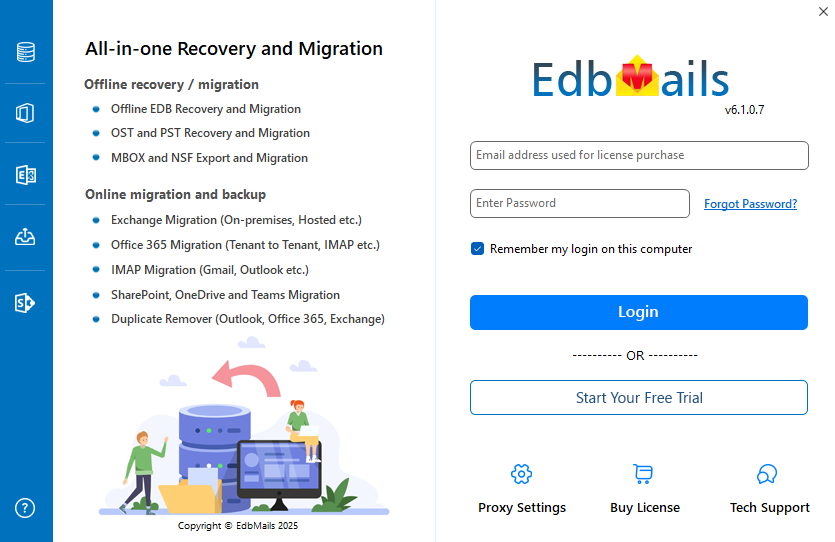
        Login to EdbMails application

      • On the EdbMails home screen, click 'Microsoft 365, Exchange, SharePoint, OneDrive, and Teams Migrations' then click 'Office 365 Migration', and select 'Office 365 to PST Export' from the dropdown.
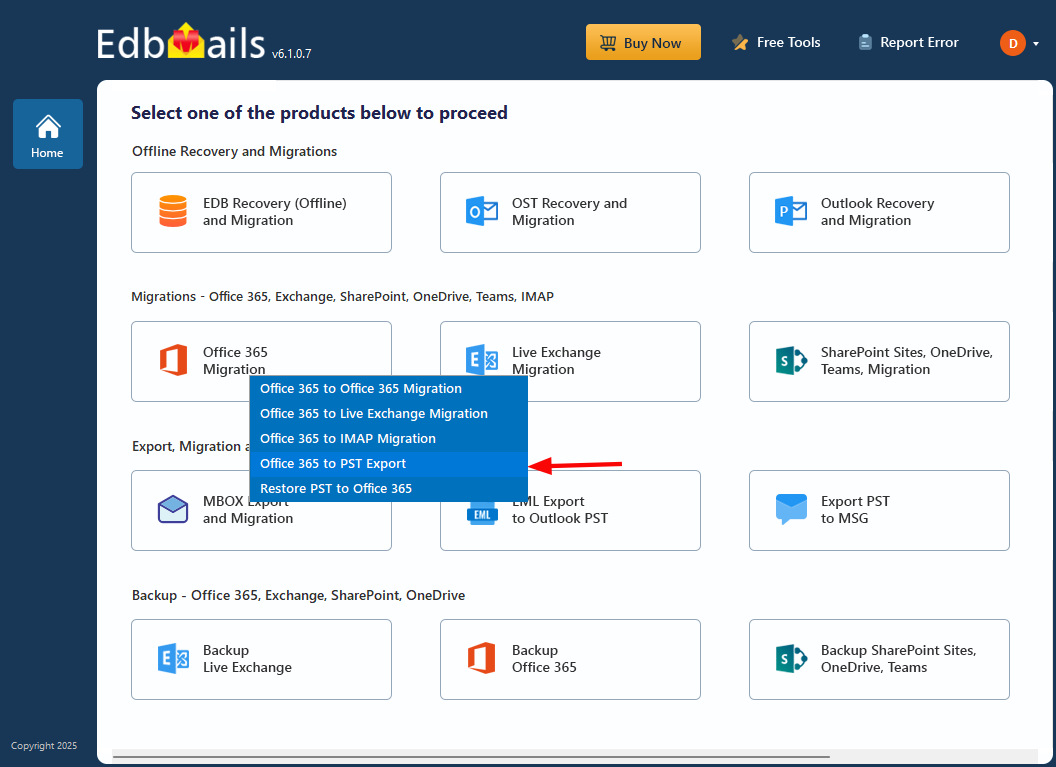
        Select ‘Office 365 to PST Export’ option

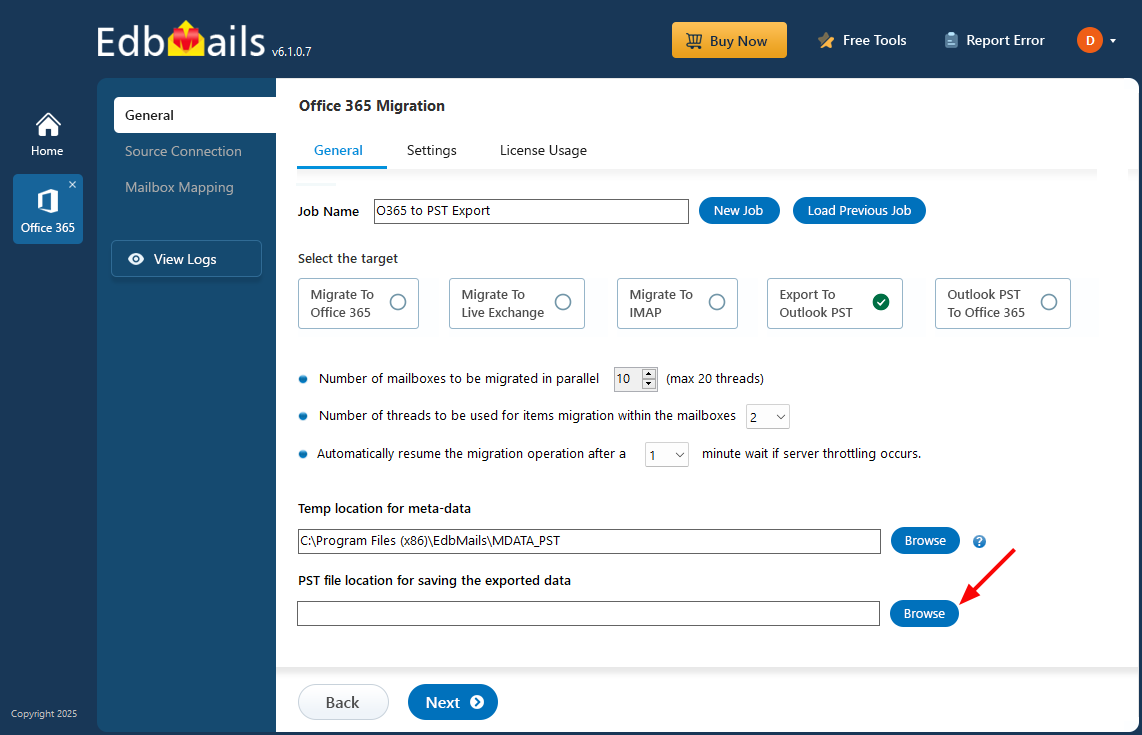
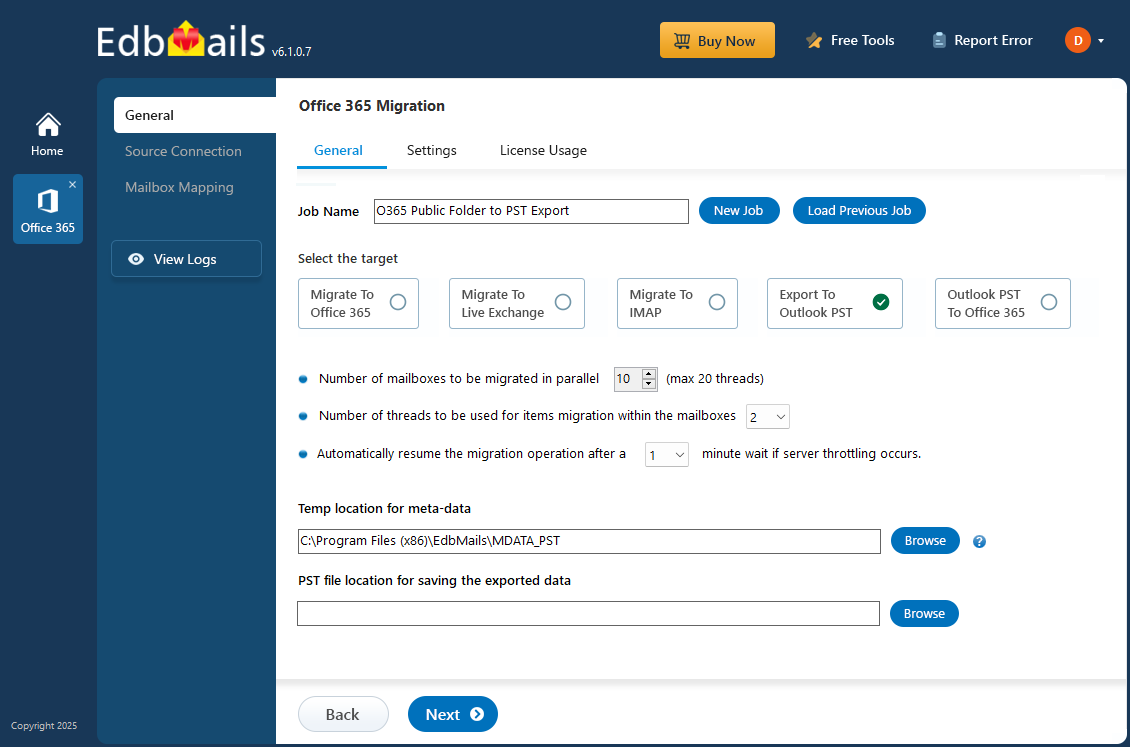
      • Keep the default job name or click the 'New Job' button to enter a custom name.
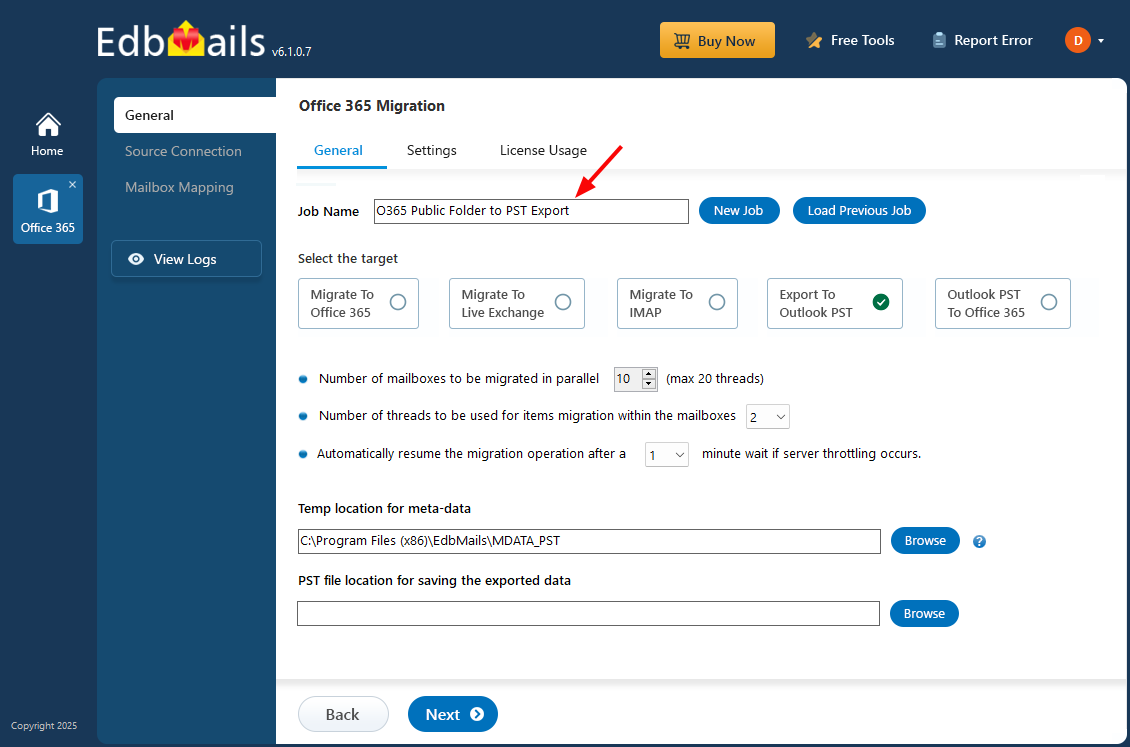
        Enter Office 365 public folder to PST export job name

      • Click ‘Browse’.

        Click browse

      • Choose the destination to save the exported PST files, making sure there's enough available disk space for storage.
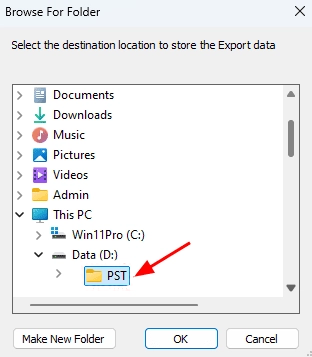
        Select PST location

    • Step 2: Connect to the source Office 365 server

      • Click the 'Add New Connection' button.
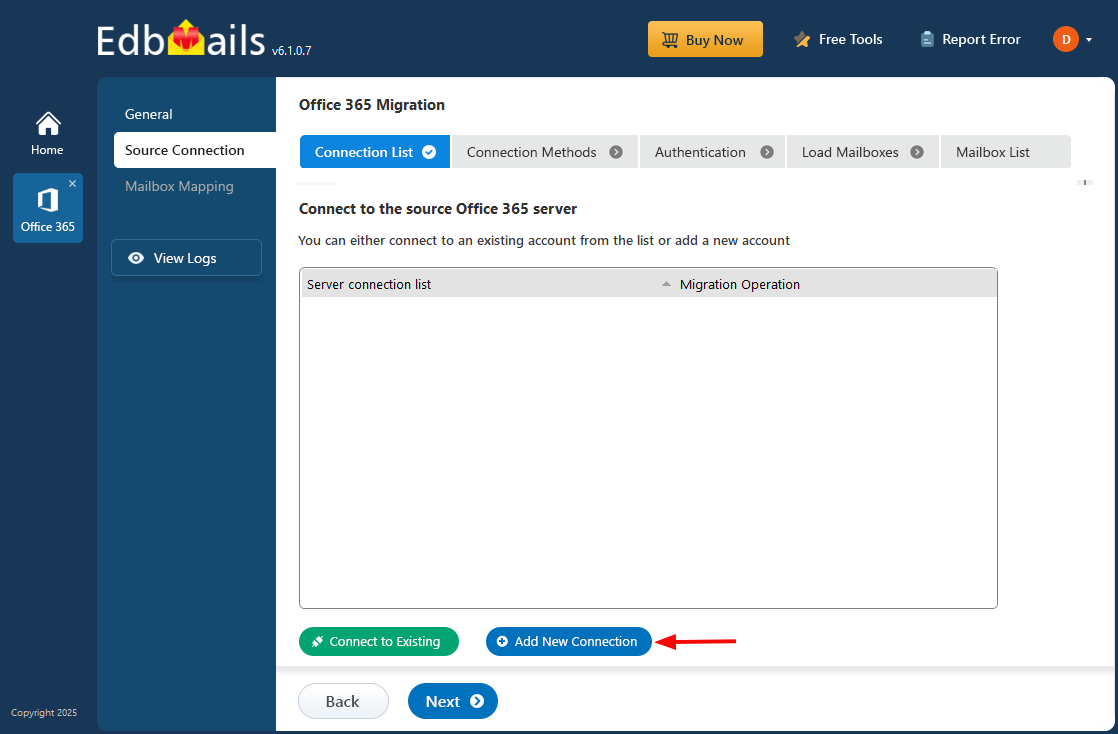
        Click add new connection

      • Select ‘Connect to Public folders’ and then click the ‘Next’ button to proceed.
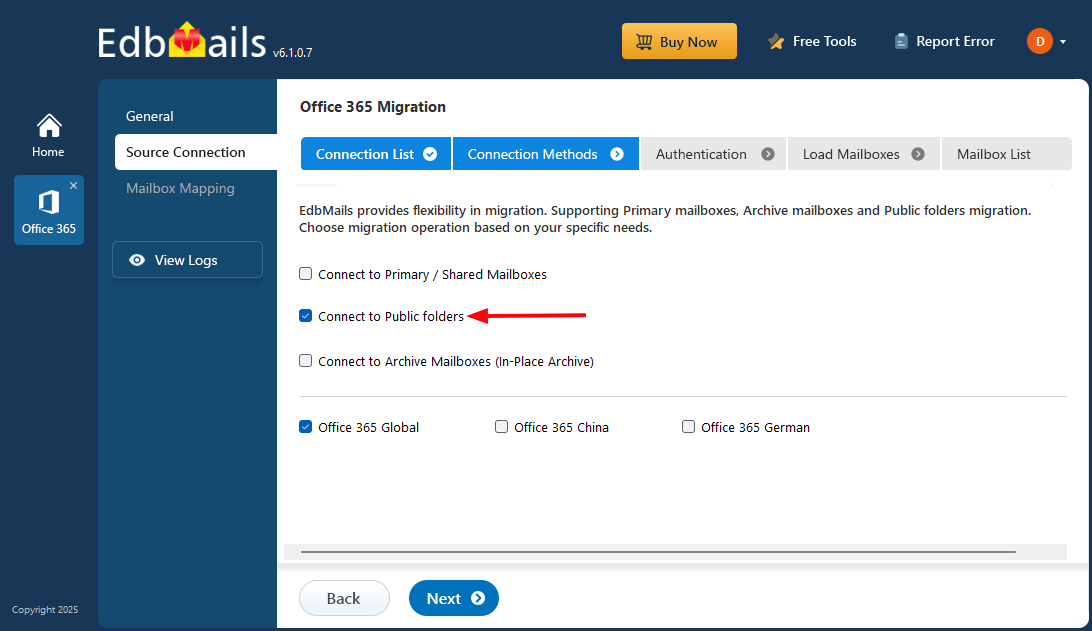
        Choose the Connect to Public folders option

      • Select the preferred authentication method and click the 'Login' button to continue.
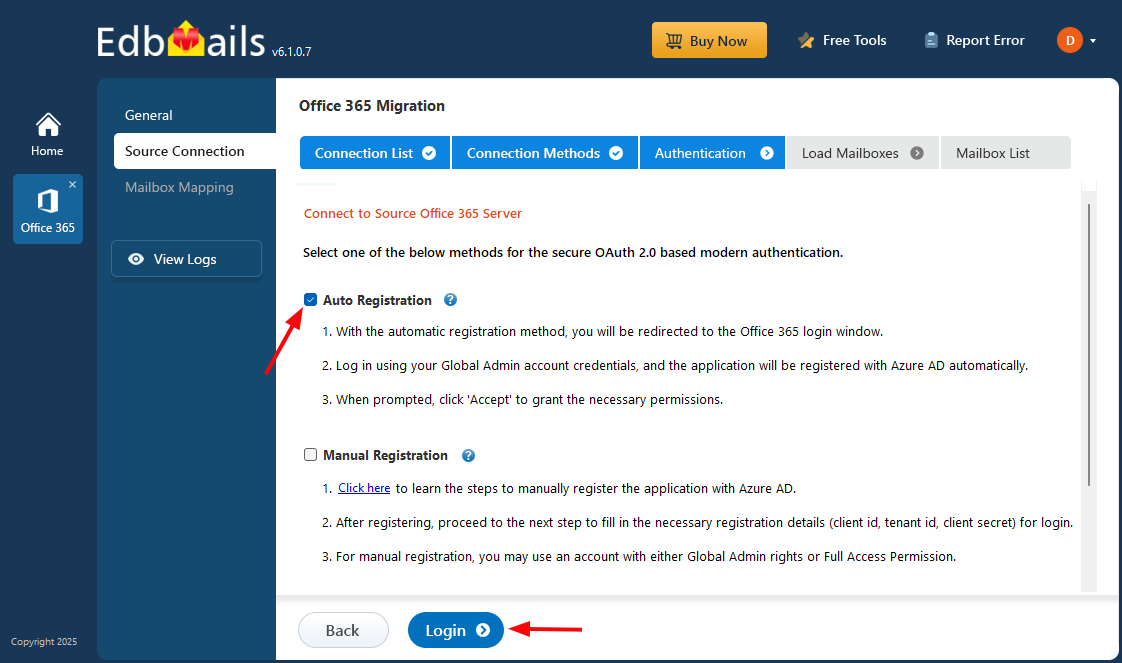
        Connect to source Office 365 server

      • Authenticate on the Microsoft Sign-in page.
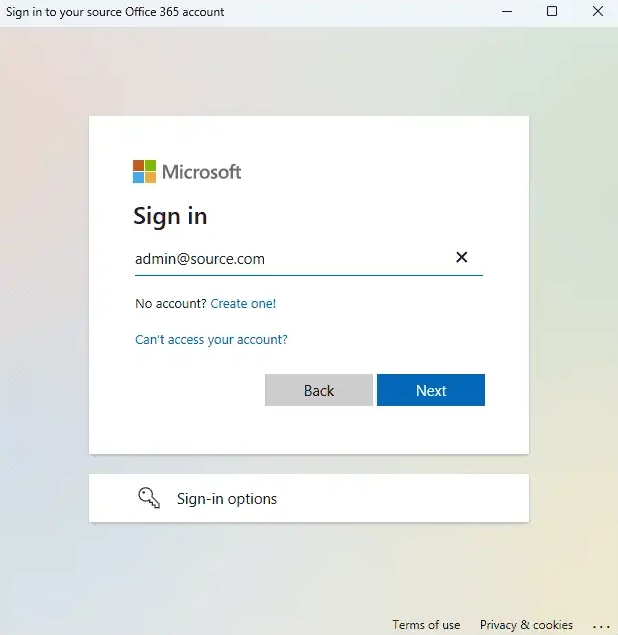
        Microsoft sign-in

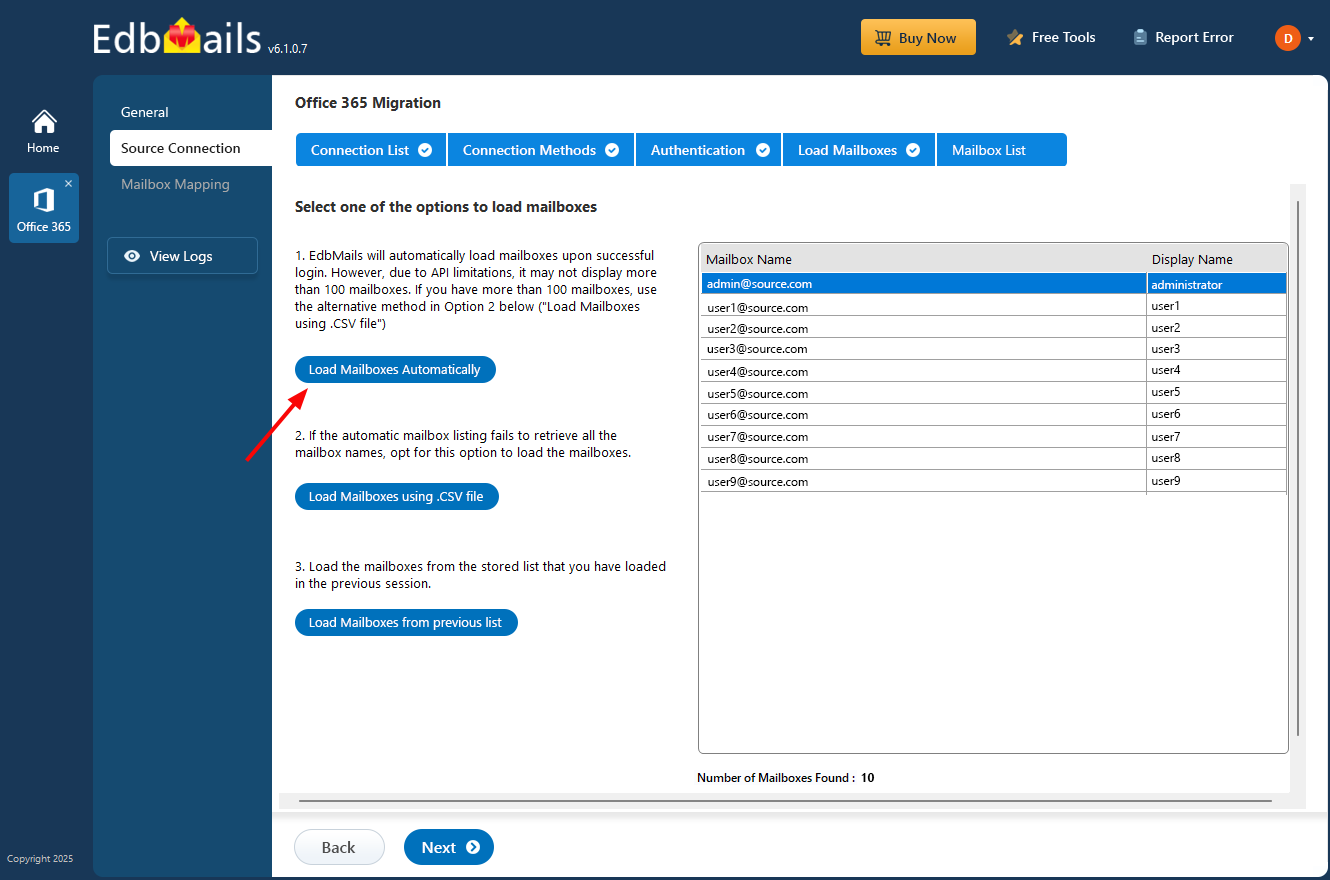
      • After successful authentication, select the option to load the mailboxes. The application automatically loads up to 100 mailboxes; if you have more than that, you can use a CSV file to load all the mailboxes.
      • Click 'Next' to proceed.

        Select the options to load the mailboxes

    • Step 3: Select Office 365 Public folders

      • Select the public folders from the left pane and click ‘Next’ to proceed.
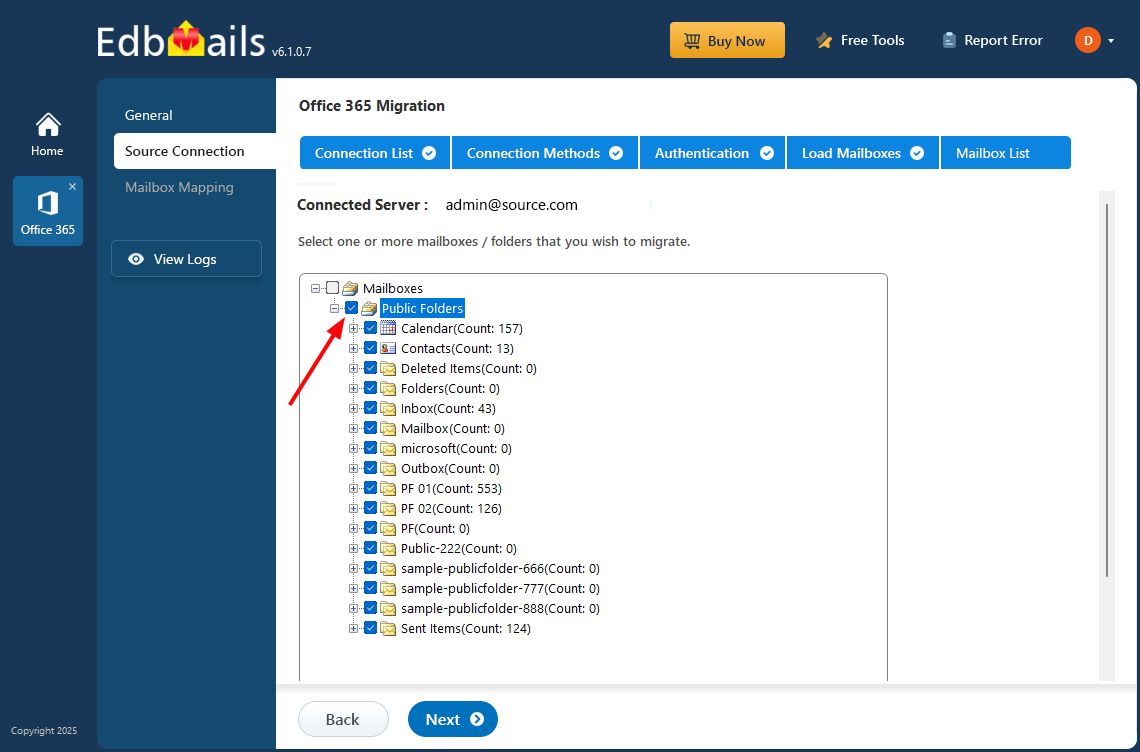
        Select Office 365 public folders

    • Step 4: Start Office 365 Public folders to PST export operation

      • Double-check the public folders selected for export and make sure the 'Action' is set to 'Export'.
      • Click 'Settings' to enable 'Split PST' for large mailboxes. Save the settings.
      • Click the 'Start Export' button to initiate the export process.
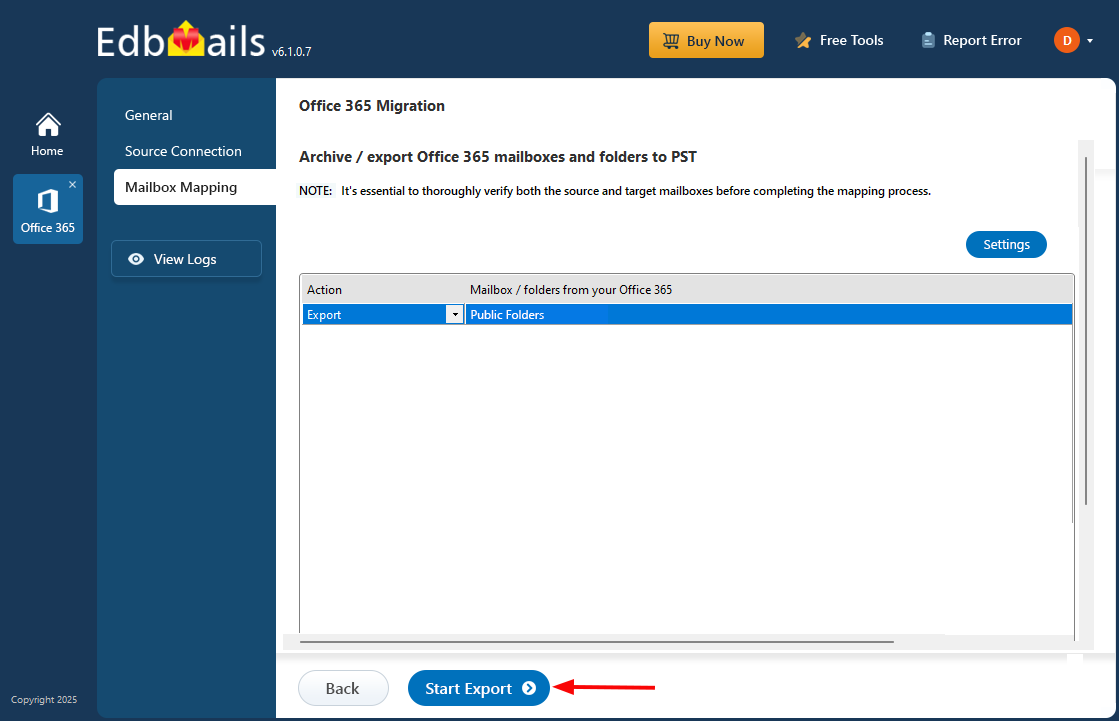
        Office 365 Public folder to PST mapping

      • You can monitor the export process status in real time within the interface. Once the export process is complete, a message will be prompted to verify the logs. Click the 'View Logs' button to view the export operation report.
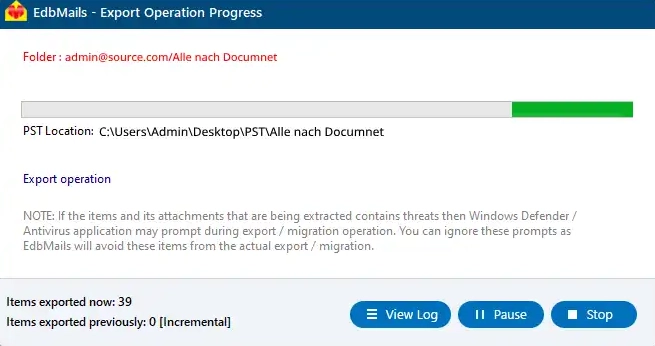
        Office 365 Public folders to PST export operation progress

      • Open the PST file in Outlook and verify the exported items.

Advantages of EdbMails for Office 365 Public Folders to PST Export

  1. Split the Output PST File

    Large PST output files can become difficult to store and move around — EdbMails gives users the option to split large PST files into more manageable sizes. For businesses working with extensive public folder data, this keeps performance stable and makes storing or transferring the exported files far less of a headache.

  2. Free PST Viewer

    Before committing to the export, the built-in free PST viewer lets users look through the PST content and confirm everything's in order. Nothing gets missed, and there's no guessing about what ended up in the output file.

  3. Free PST Merge Tool

    Got multiple PST files that need to come together? EdbMails free PST merger tool combines them into a single file - cleaner to manage, easier to access, and far more organized.

  4. Incremental Export

    EdbMails also has the feature called incremental export, which allows exporting only new and modified emails. In this way, export speed becomes faster, reduces data duplicate and avoids useless data transfer. Incremental export optimizes the export process because businesses are able to transfer data step by step.

  5. Free Trial Option

    EdbMails offers a free trial that lets organizations evaluate the software before purchasing. The free trial option allows you to export up to 30 items from each folder across all mailboxes, giving you a practical, hands-on way to assess how the tool handles your Office 365 public folder export.

Frequently Asked Questions

  1. Can I export only specific date ranges or specific public folders?

    Yes. You can filter by date range and select individual public folders before starting the export.

  2. Does the export process modify or delete anything in the source public folders?

    No. The export is read-only against the source - nothing is deleted or altered in Office 365.

  3. How long does exporting a public folder to PST take?

    The time required depends on data volume, network conditions, and Microsoft's throttling limits, which can affect how quickly data is retrieved from the Office 365 environment. EdbMails helps offset this by supporting parallel export of up to 20 mailboxes at once, making better use of available throughput. For even faster performance, you can also install EdbMails on multiple computers and export different sets of mailboxes simultaneously, further reducing the overall export time.

  4. Which license, and how many licenses, do I need to export Office 365 public folders to PST?

    To export Office 365 public folders to PST, you need an Office 365 Migration license. Exporting public folders consumes 50 mailbox licenses; with this, you can export unlimited public folders from the same domain.

     Click here to know the Office 365 Migration pricing details.

  5. Can I export data to the same PST file across multiple sessions instead of creating a new one each time?
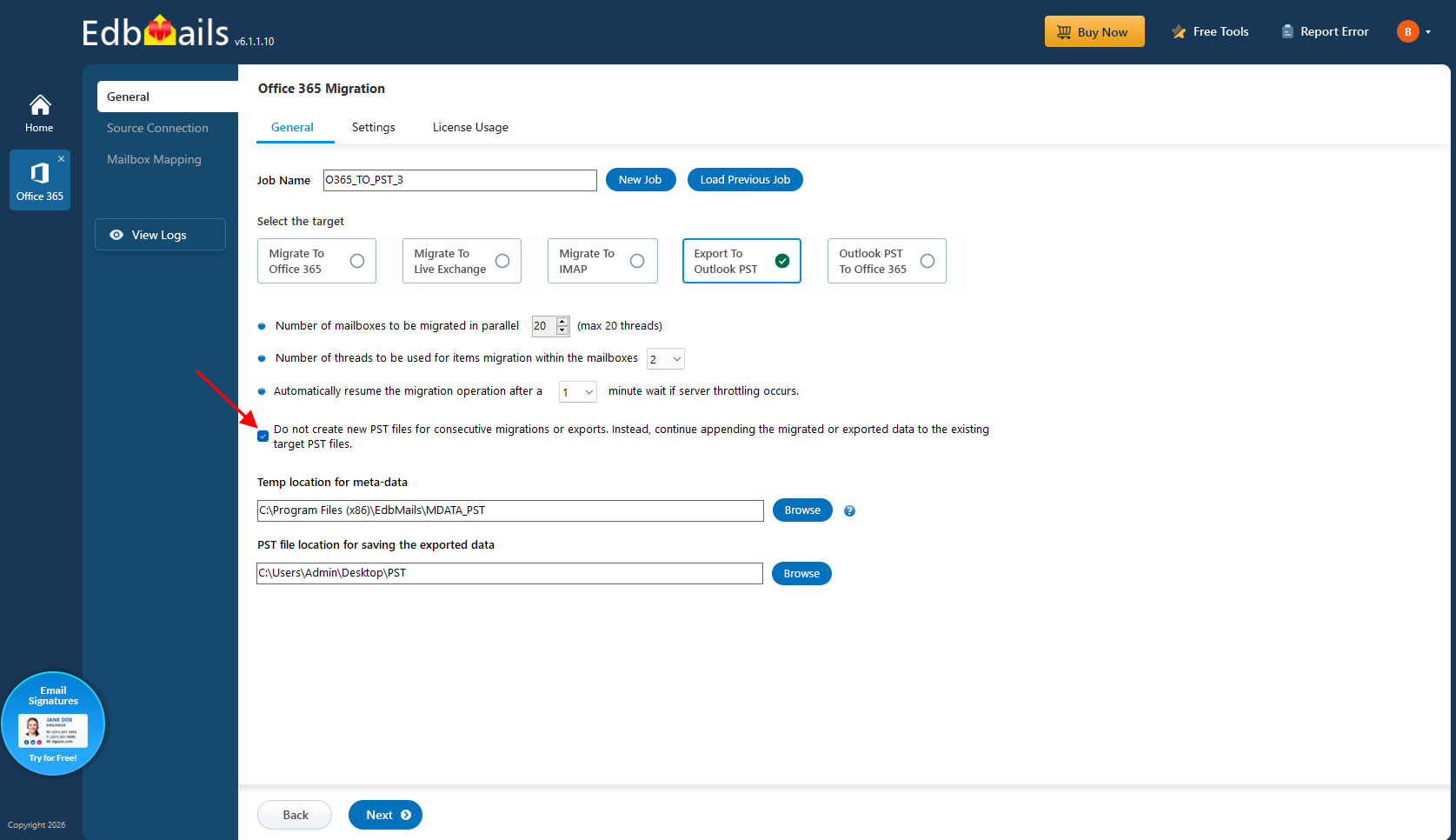

    Yes. EdbMails provides this option: "Do not create new PST files for consecutive exports. Instead, continue appending the exported data to the existing target PST files." When enabled, this ensures that repeat export runs append data to the existing target PST file rather than generating a new one each time, keeping all exported data consolidated in a single file.

    Office 365 Public folders to PST export operation progress


Additional resources:

  • Public Folder to Office 365
  • Public Folder to Shared Mailbox
  • Archive Mailbox to Office 365
  • Office 365 archive mailbox to PST
  • Office 365 Shared mailbox to PST
lady image

 In this manual

IntroductionExport PrerequisitesExport StepsEdbMails Advantages

Office 365 Migration

100 Mailboxes $299 Only

Buy Now

Need help?

24/7 Customer support

Contact us on Live chat

Personalized Demo

Book a personalized demo

Still need help?

Email us / Call us

© 2026 Shifttocloud Inc. Privacy Policy | Terms of Use | GDPR | Security | Press Releases

hidden msg
Live Chat

Hi, May I help you?

Hide Chat Now

Get instant assistance from our experts. Chat with us now for quick answers and Technical support.